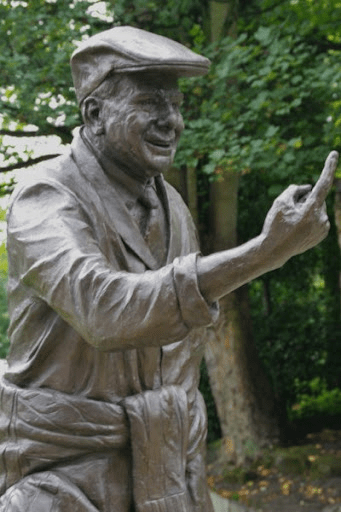
Harold ‘Dickie’ Bird passed away on September 22nd, widely mourned, at the ripe young age of 92 in his home town in Barnsley, Yorkshire. Peacefully in his sleep. Which is nothing less than the great man deserved. Now I can hear many youngsters, who follow cricket, reading this column, assuming youngsters read the newspapers (digitally or otherwise) these days, going ‘Who is this Dickie Bird? What is this fellow blabbering on about? And how can a 92-year-old man be described as young?’ One can only feel a deep sense of pity for such literal-minded ignoramuses. Or ignorami, if your Latin is up to scratch.
However, if you belong to that segment of the populace that appreciates the game of cricket, not merely to marvel at those perfect cover drives and muscled sixes, or stumps cartwheeling, or fielders taking sensational diving catches, but takes an avid interest in those ‘characters’ who have involved themselves in other aspects of the game, and found love, honour and recognition in so doing, welcome to the world of Dickie Bird. Arguably the most celebrated umpire the game of cricket has known. ‘What do they know of cricket who only cricket know?’ asked the late Trinidadian, historian, Trotskyist activist and Marxist writer C.L.R. James in his brilliant, social and cultural tour de force of the game in his book, Beyond a Boundary.
As a rule, cricket umpires are a faceless lot. They stand there, the pair of them, for long hours braving fickle weather conditions, player tantrums and spectator animus. Depending, of course, entirely on which way the umpire’s finger moves (or not), when a highly histrionic appeal is made for a leg before or caught behind. It is then, and only then, that the umpire comes under the spotlight. If there was one umpire who managed to win over crowds, players of all national hues, not to mention the administrators ever since he stood behind the stumps and announced in a stentorian voice, ‘Play,’ that umpire was Dickie Bird.
Dickie Bird was nothing if not an obsessive perfectionist. He had to be absolutely, 100% sure before he raised the dreaded finger to send a batsman packing prior to upholding a leg before or caught behind appeal. Always remembering he started umpiring long before television cameras and DRS took over most of an umpire’s decision making. Many bowlers felt Dickie was a bit of a ‘not out-er,’ strictly adhering to the old dictum of always giving the batsman the benefit of the doubt. England’s much-admired captain Mike Brearley, had this to say about Dickie, ‘My only complaint with Dickie Bird is that he requires a degree of certainty that is almost neurotic; like the man who has to keep going to the front door to make certain that he’s locked it.’ That said, he displayed nary a doubt in raising his finger with alacrity at Jimmy Amarnath’s leg-before appeal against Michael Holding, signalling India’s famous victory at Lord’s in the final of the 1983 World Cup, sending a grateful nation into rapturous celebration.
Already many emotional homages have been paid by cricketers, journalists and broadcasters from all over the world to Dickie and reams have been written about personal experiences on the field. Sunil Gavaskar getting a haircut from Dickie because an errant lock of hair was blowing into his face during a blustery day in Old Trafford, Manchester in 1974 is but one of several amusing examples. Thanks to barber Bird, Gavaskar scored 101!
For myself, as a cricket enthusiast deeply involved in matters arising on the field of play as well as the cultural and idiosyncratic ethos surrounding the game, Dickie Bird sits at the top of the tree, along with the likes of revered commentators like John Arlott, Brian Johnston and Jim Swanton. They may have played a bit of cricket in their time but it was their unique ability to bring the game to life, when television was still a twinkle in broadcasters’ eyes, that set these gentlemen apart. We were glued to the wireless reveling in their banter and witticisms. Dickie Bird was not a commentator but a raconteur non pareil. I was fortunate to pick up a double CD titled An Evening with Dickie Bird, which amply displays his wit and wisdom.
If Dickie Bird’s quirks and angularities as a revered umpire could only be enjoyed from a distance as spectators in the stands or in front of our television screens, a product of our imagination, he was a most engaging and entertaining speaker at many a cricketing soiree, where fine wine flowed in step with the heady eloquence. Much of that treasure is contained in those CDs. I can but share a few gems. That said, even if you have heard some of it elsewhere, they still bear repetition. Under the circumstances, I shall refrain from employing that age-old aphorism, ‘Stop me if you’ve heard this before.’
Dickie’s close friend of 75 years, a doughty Yorkshireman himself and sometime cricketer, later on a celebrated talk show host, the late Michael Parkinson, had this to say about our protagonist, ‘Only Shakespeare could have invented a character so full of life’s rich juices as Dickie Bird. Cricket’s genius has been to accommodate his foibles and celebrate his humour.’ Coming as he did from a relatively humble background, Dickie’s humour was that of the rugged Everyman of lore. Here’s a snippet of what he had to say when the Queen invited him to receive his OBE. Evidently, he got a call from the Queen’s office inviting him for lunch. ‘I said – because I thought someone was taking the mickey – if I have been invited to have lunch at Buckingham Palace, I will walk to it from Barnsley.’ He ultimately took that long train journey to London to visit the Queen. Arriving at the Palace much too early, he showed his special pass to the Bobby on the beat at the Palace gates and was told he can’t go in till the Changing of the Guards. When informed that he had come to have lunch with the Queen, the policemen told him to kill some time at a tea shop round the corner. He killed four hours and finally was let into the pearly gates. Anyhow, Her Majesty took one pitying look at Dickie and said he’d better have a drink and he replied, ‘If I may, I will have a glass of red wine and she said, “I’ll have a drink with you, Dickie.”’ Just a gentle, civilised interaction between a commoner and Royalty, but it is the way Dickie tells it that will have you in stitches.
About the great if controversial Geoff Boycott, another Yorkshireman, Dickie’s wry comment – ‘I am the only one he talks to. He hasn’t got a friend in the world, but if I wanted someone to bat for my life, that would be Boycott.’ Then there was that occasion when Sachin Tendulkar, all of 16 years old, playing an ODI in Sharjah for the first time against the West Indies, met the great Dicke Bird, who asked the young adolescent, if his school had granted him leave to play cricket for India. And Tendulkar replied (in Dickie’s mock imitation of Sachin’s high-pitched, teenage voice), ‘My headmaster has given me permission to play for India, Sir.’ Bird goes on to say, in awed tones, that Tendulkar scored 89 against the likes of Walsh and Ambrose!
There are many more such examples from these recordings that one could cite. Suffice it to say that Dickie Bird was one of a kind. They broke the mould after him. Deservedly, a statue of him is erected in Barnsley. A fitting tribute. Had he been with us and officiating in the just-concluded, fractious Asia Cup fixtures between India and Pakistan, he would have called the captains after the game and told them gently but firmly, ‘Now come on lads, stop mucking about. You are not chokra boys. Shake hands like gentlemen and leave your politicians to indulge in all the argy-bargy.’
R.I.P. Harold ‘Dickie’ Bird.
Published in Deccan Chronicle on October 1, 2025.


 Suresh's Corner
Excellent piece, Suresh!
LikeLike
Thanks JB.
LikeLike
Another beauty Suresh. You are such a good writer. Sachi
Thank you.
Sachi Mukerji
LikeLike
As yours ever, brilliant. Sir,with l his King Solmonish cricketing judgments , there is no recorded account that he played the game himself , even whatever they call in Yorkshire resembling our Gully cricket. Pray enlighten me Regards Raman
LikeLike
Thank you. He played first-class (County) cricket for Yorkshire and Leicestershire between 1956 and 1964 before taking up professional umpiring.
LikeLike
Happy Vijayadashami
LikeLike
And the very same to you.
LikeLike
Indians do long remember the TV visual of Mr Bird giving Michael Holding out LBW to Mohinder Amarnath with alacrity, to seal India’s 1983 World Cup victory.
LikeLike
Indeed yes. A magical moment, that.
LikeLike
Thanks to your valuable input, I have added a few lines on that 1983 World Cup decision. You will find it at end of the fourth paragraph.
LikeLike
Very well paraphrased, Mr Subhrahmanyan. NJP
LikeLike
Excellent. – the cast was broken after him- wah.
LikeLike
Beautiful writing. If I understood correctly “they broke the cast after him” is a brilliant usage- can be used to any unique personalityRaghavan
Yahoo Mail: Search, organise, conquer
LikeLike
Thank you. The actual usage I employed was ‘they broke the mould after him,’ but cast works equally well.
LikeLike
it seems that they broke the mould after me, too – a person so absent minded and impoverished memory!!!
LikeLike