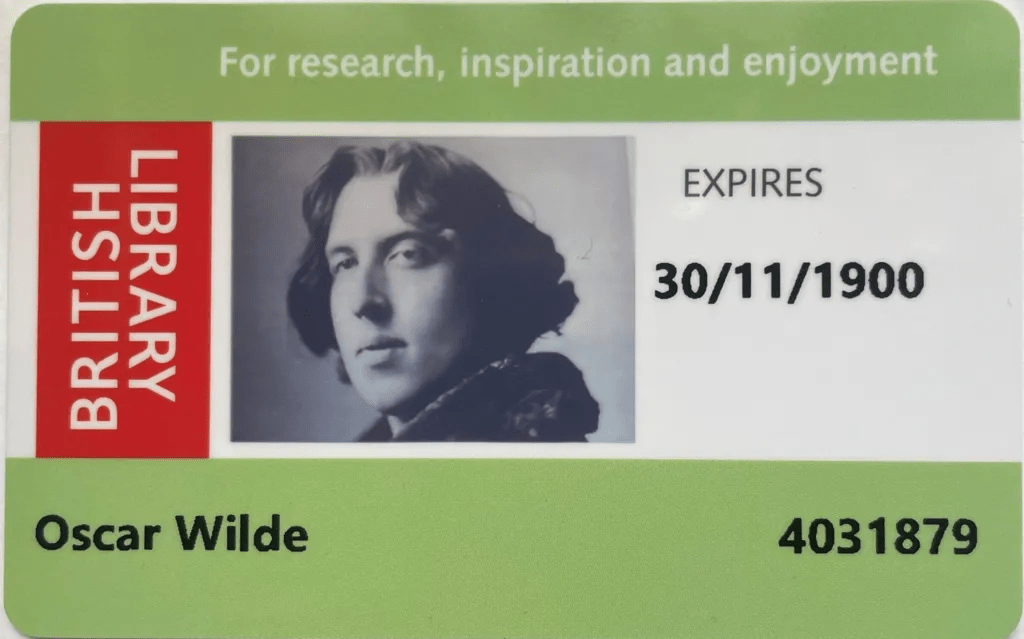
It is only when one has lost all things, that one knows that one possesses it. Oscar Wilde.
Tucked away in an insignificant corner of my morning daily was the news that the legendary, if controversial Irish novelist, playwright and poet Oscar Wilde’s library card was reissued 130 years after being revoked over a gay conviction. Wilde’s unconventional (for those days) sexual proclivities did not endear him to the powers-that-be at the turn of the 20th century. In medieval times, they would have burned him to a crisp at the stake. Or hanged, drawn and quartered. As it was, he was incarcerated for two years hard labour between 1895 and 1897 to atone for his ‘sins.’ In keeping with the temper of the times he brought widespread ignominy on himself. That said, every cloud has a silver lining. During his stint in jail Wilde wrote his bittersweet essay De Profundis, which was in fact a 50,000-word letter to his erstwhile, jilted lover, Lord Alfred Douglas, himself a poet and journalist. Soon after his release from prison, Wilde’s monumental poem The Ballad of Reading Gaol was published.
It would not be too much to say that the man who wrote those light-hearted societal comedies, The Importance of Being Ernest and Lady Windermere’s Fan and the more serious Gothic novel The Picture of Dorian Gray, among several other notable works, was reduced to a byword and a hissing among the cognoscenti of the time. With the passage of the decades, ‘Time, the great healer’ has decided to get into the act and play The Good Samaritan. A bit late in the day, 130 years late, but still welcome. The British Library has now sought to make amends by honouring Wilde through reissuing a reader’s card in his name. The original card was revoked following his conviction for ‘gross indecency.’ He was banished from the library’s reading room in 1895 over his charge for having had homosexual relationships, a criminal offence at the time and convicted bang to rights.
The new card, delivered to his grandson, author Merlin Holland, is intended to ‘acknowledge the injustices and immense suffering’ Wilde faced, the library said. Mr. Holland said the new card is a ‘lovely gesture of forgiveness and I’m sure his spirit will be touched and delighted.’ As a lover of the English language and literature one is immensely pleased that Oscar Wilde’s unjustly tarnished reputation has now been restored to its rightful place. Good on you, British Library.
Unfortunately, I did not enjoy quite the same luck with the British Council Library in Calcutta during my long period of residence in that colourful city. Let me hasten to add that my sin was laughably minor compared to Wilde’s perceived and (mis)judged misdemeanours, but more of that anon. I became a member of the British Council, or BC as we fondly called that institution, during my university days. Located on the tony Theatre Road, later appositely renamed Shakespeare Sarani, obtaining a membership to the BC was a piece of cake. All one had to do was furnish one’s college identity card, flash a smile at the comely librarian and in the blink of an eye, you were handed the membership card with your name duly printed and a library number to go with it. It was almost a badge of honour that you proudly carried around in your wallet. Several years later, on entering the corporate world, one experienced the same sense of pride on being accepted as a member of one of Calcutta’s prestigious social clubs, such as the Saturday Club or the Calcutta Cricket and Football Club.
Apart from the wonderful selection of books that the BC stored, many of us made a beeline for the library for other reasons. First and foremost was the excellent air-conditioning, which was a godsend in a swelteringly hot and humid city like Calcutta. I am talking about the late 60s and 70s when the ironically named City of Joy suffered unscheduled power cuts for interminably long hours during the day. Even in those days, the BC had its own back-up generator, which enabled us to sit in considerable comfort in the capacious reading room, pretending to pore over some voluminous tome or the other. Occasionally, a gentle snore would emanate from a senior citizen who had wisely decided to use the bulky 80-page Sunday Times as a makeshift pillow, for his post prandial siesta.
As for us undergrads, let us not forget that many of the girls from other colleges also found the BC an intellectual and convenient haven to meet up with their boyfriends. Libraries the world over had a strict ‘observe silence’ policy. Between the boys and the girls, therefore, it had to be a strictly ‘whisper sweet nothings’ strategy. Eye contact only. The icing on the cake was that our library had a vinyl record collection of unusual material. A case in point being a long-playing record of Oscar Wilde’s The Importance of Being Ernest featuring legendary thespians like Sir John Gielgud and Sir Ralph Richardson among other notables. A wide collection of Shakespeare’s plays was on offer as well. The BC was also well-stocked with plenty of sterling stuff from the BBC’s record archives. However, if you were browsing hoping to find The Beatles or The Rolling Stones, you would have been sorely disappointed. That said, popular musicians of that era flaunted their erudition and love for literature, frequently namechecking their heroes. Here is Irish bard Van Morrison, ‘Tell me of Poe, Oscar Wilde and Thoreau / Let your midnight and your daytime / Turn into love of life.’
Getting back to why I did not enjoy Oscar Wilde’s luck (having his library card restored posthumously) had nothing to do with anything so murky as the great writer was punished for. Apart from the salient fact that I was and am still alive! It was a simple, mundane matter of a ‘late fee.’ The BC were sticklers for rules. You were permitted to keep the books you borrowed for a maximum period of two weeks, with a permitted extension of an extra week if you called in and informed them. The librarian smilingly and a tad resignedly, told me that on one occasion, she received as many as 27 calls from borrowers seeking an extension as they were struck down, ‘bedridden with the flu.’ Evidently on an epidemic scale! Any further delay would have invited a stiff fine. More tardiness, sickness real or imagined notwithstanding, could put you in the dreaded black list for expulsion. When I tell you that the shame of being expelled from the BC was roughly equated with Oscar Wilde’s own misfortune, you will understand why we students were desperate to return books on time. In my own case, I had to grovel and plead to retrieve my card.
As I sit and contemplate the unique case of Oscar Wilde and libraries in general in the year 2025, I wonder if public libraries exist in the same profusion as they did several decades ago. If they do, it is a moot point how many people visit these libraries. School and college campuses will have them, that is a given. Last I heard, the venerable National Library in Calcutta, formerly known as the Imperial Library, stands more as a grand monument to British architecture than as a house of learning and research, reflected in the paucity of visitors. This unfortunate situation can partly be attributed to reading material being more easily available on the internet. More significantly there are far fewer people, in particular youngsters who take the time and effort to read a book from cover to cover. Someone recently wrote, only partly in jest, that more books of J.K. Rowling are sold and ostentatiously displayed in home libraries than read. After all you can watch all the Harry Potter oeuvre on cable television and sound extremely well read in peer group company.
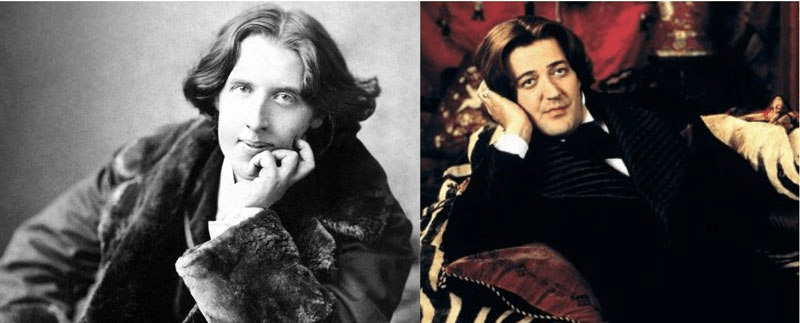
When the brilliant actor, writer and peerless raconteur Stephen Fry was chosen to reprise the role of Oscar Wilde in the 1997 biopic Wilde, the serendipity was uncanny. For one thing, Fry more than passably resembled Wilde. More to the point, he was avowedly and proudly gay. It was an inspired casting made in heaven and here is what Fry himself had to say about it in an article for the New Yorker, ‘If I were to say that all my life had been a preparation for playing Oscar Wilde, I would (aside from sounding ridiculous) be laying my tender rear horribly on the line. Yet I had been made to feel for years that this might be true. I have had archly nudged into me the winsome phrase “born to be Wilde” more times than I care to remember. “The chubbier you get the more you look like him,” I have been told. “If you can’t, no one can.” And “Let’s be honest. With a face like yours, it’s the only lead you’ll ever get. Otherwise, it’s a life of Gestapo interrogators, emotionally constipated cuckolds, and Bond villains.”’
The man who played Oscar Wilde so convincingly on celluloid received handsome plaudits for his performance. We should thank our lucky stars that we live in more enlightened times when Stephen Fry was not expelled from a library or any other public institution. For on screen, Fry did not play Wilde. He was Wilde. He did not receive an Oscar for his role, but the real, late Oscar would have smiled benignly from heaven. Always assuming the Pearly Gates were not barred to him.


 Suresh's Corner
Now tempted to read Oscar Wilde. Good article. Thanks
LikeLike
Now tempted to read Oscar Wilde. Good article. Thanks
LikeLike
Dear Mr. Suresh’ My reading of books in English were the 5 books prescribed for the Delhi Board Highrr Secondary Exam in the early 50s. ( My Experiments with truth , Ideas that moved the World, A book of English Prose, A Gleaner’s Harvest (poems) and another book as non detailed study) Of course, a classmate gave an unexpurgated edition of Lady Chatterly’s Lover which I read on the sly. Many years later, I read a few P G Wodehouse novels. I mention all these to express my awe at your wilde( misspelt intended) reading of English literature. I too took membership of British Council library in Delhi more to read history and political science books for my civil services exam while working in a govt office . Stanley Lane Poole and Appadorai fed my insatiable appetite for Indian history and political science respectively. I thought I would meet you in Bengaluru during my next visit to my daughter’s there. But it looks it won’t be soon. A source tells me that Sh. Sanjay Subrsmanian the noted Carnatic vocalist is perhaps related to you .Is it so ? Regards Raman ,
LikeLike
Good one, Suresh!
LikeLike