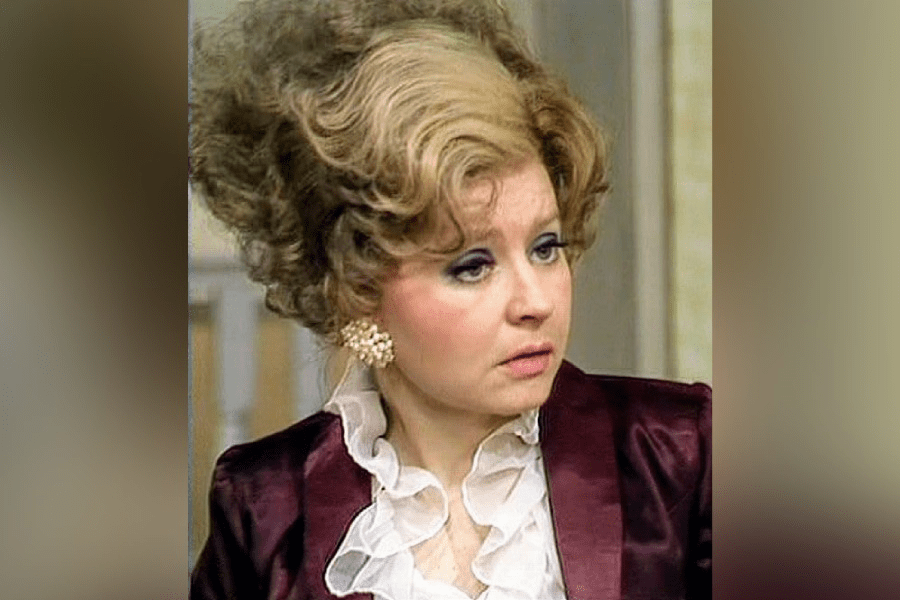
‘Actors go into it because it gives us the chance to play people a great deal more interesting than we are, and to say things infinitely wittier and more intelligent than anything we could think of.’ Prunella Scales.
Prunella Scales died last week at the ripe old age of 93. Those of you who may not be familiar with her work, I seek your indulgence. However, to most of us who know of her, the sole point of reference can only be her role as Sybil Fawlty in the iconic, 12-episode television sitcom of the mid-70s, Fawlty Towers. She was one-fourth of the quartet that has made Fawlty Towers the best loved comedy on British television to this day. What is more, its fame has spread to most parts of the English-speaking world. The remainder of that fabulous quartet, I need hardly remind you, were the creators of Fawlty Towers, John Cleese as Basil Fawlty and Connie Booth as the maid Polly. Not to forget Andrew Sachs as the hapless Spanish waiter Manuel, who passed away a few years ago and about whom I wrote an obit piece on that sad occasion. On the off-chance that there are those among you who have not had the pleasure of viewing Fawlty Towers, highlights from the series (if not the full episodes) can be accessed on YouTube.
Getting back to Prunella Scales as Sybil, who together with her fictional husband, John Cleese as Basil, ran the coastal resort hotel Fawlty Towers in Torquay, on the south west of England. Her constant run-ins with her husband’s unintended japes and his inability, quite literally, to put one foot in front of the other without tripping up horribly, had us in stitches. She was viewed as a harridan by her husband and the limited staff of the hotel, but her customers loved her. Prunella Scales had the unique ability to combine comedy with a finely-honed understanding of timing, an ability that endeared her to millions of fans who couldn’t get enough of her. And, in fairness, the rest of the cast as well.
Such has been Prunella Scales’ indelible association with Fawlty Towers that one might easily overlook her distinguished, multi-faceted acting career spanning over 60 years on stage, film and television. Suffice it to say that the average denizen on the street knew her only as Sybil Fawlty, having no idea what her real name was. The roles she essayed elsewhere were many and too numerous to list here. Prunella Scales was not just a one-trick pony dishing out slapstick comedy. Perhaps one of her more serious roles, one that earned her widespread acclaim was that of Queen Elizabeth II in A Question of Attribution, a one-act stage play, subsequently adapted to film, written by well-known playwright Alan Bennett. In short, Scales has demonstrated her ability to play all manner of roles and her status as a thespian to match many hallowed names that bestrode the world of British theatre and film, remains undiminished. She was made Commander of the Order of the British Empire (CBE) in the 1992 Birthday Honours List, along with a slew of other notable awards. She was personally known to Queen Camilla whom she met socially off and on.
Piquantly, a noted rose breeder in England named a rose after her name, Prunella.
On a personal note, my awareness of Fawlty Towers happened by chance in 1981 when I was working for a well-known tyre company in Calcutta. Our Managing Director was a Scotsman who was to retire shortly to return to the UK. At his farewell party where he was showered with the usual encomiums, he drew me aside and handed me a cloth bag containing four video cassette tapes containing all the 12 episodes of Fawlty Towers, about which I knew nothing at the time. ‘I think you will enjoy these tapes,’ he said to me. I was overwhelmed receiving a gift from our Big Chief whom we were bidding farewell to that evening. And that he had sussed out my fondness for British comedy. That was the beginning of my love affair with Fawlty Towers (a silent ‘thank you’ to Mr. Alistair MacIntyre). In subsequent years, I got myself the entire DVD set of the series, which is imperishable. If I told you I have viewed them on fewer than fifty times over the years, I would be telling a lie. A hundred times would be nearer the mark. And still counting.
I would like to conclude this tribute to Prunella Scales and to the television series she helped make so memorable, as I leave with you some of the most risible quotes from the series. Many of them will be better appreciated if viewed in context, but I will have to take that chance. Those of you who have not seen the episodes of Fawlty Towers, find a way to access it online or by any other means. If you have, then watch it again. You cannot get enough of it. God knows we could all do with a laugh in these toxic times we live in.
Basil Fawlty: ‘Don’t be alarmed. It’s only my wife laughing.’
Sybil Fawlty: ‘I can’t abide cruelty to living creatures.’
Basil Fawlty: ‘I’m a creature and you can abide it to me.’
Sybil Fawlty: ‘You’re not living.’
Basil to Sybil Fawlty: ‘Do I detect the smell of Burning Martyr?’
Basil Fawlty: ‘A satisfied customer. We should have him stuffed.’
Mrs. Richards (a dotty, aged, stone-deaf guest): ‘Faulty? What’s wrong with him?’
Sybil Fawlty: Psychiatry, that’s a relatively new profession, isn’t it?’
Psychiatrist’s wife (a hotel guest): ‘Freud started it in 1886.’
Sybil Fawlty: ‘Yes, but it’s only now we’re seeing them on the television.’
Polly (the maid): ‘Could I have a raise? Mrs. Fawlty said it would be alright.’
Basil Fawlty: I don’t think we see eye-to-eye vis a vis the frozen assets.’
Basil Fawlty: ‘Well, let me tell you something. This is exactly how Nazi Germany started! A bunch of idiots sticking their noses in, looking for something to complain about!’
Major Gowen (a senile, eccentric permanent resident): ‘The strange thing was that throughout the morning, she kept referring to the Indians as niggers. No, no, I said, niggers are the West Indians, these people are wogs!’
Regarding that last quote, John Cleese narrated recently that almost 50 years after the first telecast, hyper-sensitive, thin-skinned, literal-minded activists have suddenly woken up and objected to the use of pejorative racial stereotypical terms in Fawlty Towers. Cleese stoutly defended himself saying that was the way some people spoke in those days and that he himself does not support the views of the fictitious Major Gowen. Speaking of which, I was myself taken aback when I came across the word ‘nigger’ in a novel by the much-loved and adored P.G.Wodehouse, written around the early part of the 20th century. Much heated debate has ensued over the deletion of the term in subsequent reprints of the novel. The jury is still out.
Well, that was just a soupçon of the biting irony and wit from Fawlty Towers, and there is a lot more where that came from. If this does not drive you to go and watch all the 12 episodes in one binge sitting, you are more to be pitied than censured. Prunella Scales,’ or rather, Sybil Fawlty’s passing gave me as good an excuse as any to relive one of my favourite television comedies. Sharing it with you, dear reader, only doubles that pleasure.


 Suresh's Corner
Thank you Suresh ji .Your blogs are gradually becoming more and more informative specially for persons like me. Keep going Sir. Raman
LikeLike
Thank you so much.
LikeLike
👍.
Makes we want to rewatch the Series.
LikeLike
You must Anjum.
LikeLike