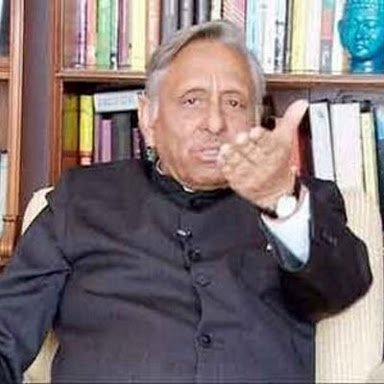
My friend, the redoubtable and irascible Congressman Mani Shankar Aiyar, has never taken a backward step when calling a spade a shovel, irrespective of the consequences. In the present instance, the spade (or shovel) is represented by one Pawan Khera, one of the Congress Party’s many spokespersons, who recently hove into Aiyar’s cross-hairs. While speaking to the media in Trivandrum, he called Khera, whose eyes incidentally are too closely set together for my comfort, a parrot, a ‘tuttoo’ meaning a lackey whose credentials to be the party’s spokesman beggars belief when there are so many others who could have done a much better job: Aiyar’s views, not mine. Aiyar was scathingly caustic about Khera and as far as he was concerned, he invited the devil to take the hindmost, in a manner of speaking.
Aiyar went so far as to describe the Congress party’s General Secretary, K.C. Venugopal as a ‘rowdy.’ He even directed his opprobrium at his party’s poster boy, Shashi Tharoor, characterising the suave politician as an ‘unprincipled careerist’ who is eyeing the foreign minister’s post in the BJP Government! To be fair, it must be said that Tharoor has been fairly even-handed in his utterances towards the ruling dispensation, giving debit or credit where it is due. Whew! Let me get my breath back. Clearly, Aiyar was pulling no punches, as is his wont, and the lascivious media lapped it all up. So far, the Congress high command has chosen the path of least resistance, turned the other cheek despite Aiyar having thrown down the gauntlet, but Khera could be smarting and looking for comeuppance, without the requisite arsenal, keeping the powder dry. The ruling BJP has no love lost for Aiyar either, but opportunism being the name of the game, they are having a field day rolling in the aisles with mirth at their nemesis’ (the Congress Party’s) discomfiture. The Germans have a word for it: Schadenfreude.
My own advice to Khera, not that he is remotely within my ambit of influence, is to quote evolutionary biologist and author Richard Dawkins who said of his late friend, the incandescent polemicist and atheist Christopher Hitchens, ‘If you are ever invited to debate with Christopher Hitchens, decline.’ In India Aiyar, whether you subscribe to his views or not (and not many do), is in a different league when it comes to verbal jousts: the enfant terrible of the Congress Party. In that sense, he is suis generis and many will say ‘thank God for that.’ Significantly, he describes himself as a Gandhian, Nehruvian, Rajivian but not a Rahulvian. Whether the Gandhian includes Indira or just the Mahatma is a matter for conjecture. So put that in your pipe and smoke it, Mr. Khera. Aiyar even stated, should he be shown the door by his party, that he would not hesitate to administer a swift farewell boot up the backside of the errant Khera. Aiyar’s ire is there for all to see in full glare. What you see is what you get. It all makes for great copy and the media lap it up like so many ravenous Cocker Spaniels slavering over a bowl of mince.
Which set me off on another train of thought altogether. I did some research to glean more instances of political leaders giving as good as they got from their rival opponents. And came up with a few nuggets.
Clement Freud, British broadcaster and politician, famously known as Sigmund Freud’s grandson, once described his Prime Minister Margret Thatcher as ‘Attila the Hen.’ There is no known reference to the Iron Lady’s response to Freud’s barb but sources close to her claimed she elected to opt for ‘the lofty ignore.’ Touching on arguably Britain’s most celebrated Prime Minister, she was never short of a witty barb herself, when it came to putting one over her opponents. Legend has it that it was the Soviets who nicknamed her the Iron Lady, with a tinge of sarcasm. Rather than taking umbrage, Thatcher embraced it by remarking, ‘If you want anything said, ask a man; if you want anything done, ask a woman.’ When, at a Conservative Party Conference, Thatcher was being pressurised to perform a U-tun on her right-wing economic policies, she memorably responded with characteristic hauteur, ‘The Lady’s not for turning,’ which was an approving nod to Christopher Fry’s 1950 comedy play, ‘The Lady’s not for Burning.’ And while taking the Labour Party head-on during the 1950s, campaigning as a callow 24-year-old, Margret Roberts, she went to the hustings and appealed to the voters with these memorable words, ‘Vote Right to keep what’s Left.’ Our own Prime Minister Narendra Modi, always on the lookout for a clever put down, might take a leaf out of Thatcher’s book. Suitably rendered in the vernacular, of course.
Speaking of iron ladies, India’s much beloved and equally reviled Prime Minister, Indira Gandhi did not lag behind, giving to her opponents as good as she got. If not quite in the Thatcher mould, she had her own calm and calculated way of putting people firmly in their place. Renowned for her sharp wit, icy composure and rapid, incisive repartee, she often used these skills to dominate political opponents and world leaders. Her ability to deliver ready retorts was considered a hallmark of her leadership. During a particularly tense encounter with her nemesis, U.S. Secretary of State Henry Kissinger, who urged her to display more patience, she cooly responded with a smile, ‘Thank you Mr. Secretary. Although India is a developing country, we possess a strong backbone.’ She even upbraided her party colleagues by issuing this stern homily, ‘There are two kinds of people, those who do the work and those who take the credit. Try to be in the first group, there is less competition there.’
Thatcher’s ‘burning’ parallel did not escape Indira Gandhi either, as she tellingly said, ‘All my games were political games. I was like Joan of Arc, perpetually being burned at the stake.’ Did she suffer from the ‘burning martyr’ syndrome? Not on your nelly. She was too strong and proud to feel sorry for herself. Those party leaders from her own flock who viewed her as a goongi gudiya (dumb doll) had to eat their own words. Finally, on being frequently compared, rather unfavourably with her father, she said, ‘My father was a statesman, I am a political woman. My father was a saint. I am not.’ Canonizing her father might have been a bit much but sadly, her nemesis was the infamous Emergency when she fell on her own sword, but that is another story.
Time was when Parliamentary debates, even when matters got really heated, always erred on the right side of civility and decorum. Those days are gone. We live in a witless age. We may have built a new home for our Parliament in the capital, but the proceedings, more often than not, are an absolute shambles, taking us back to the stone age. Rival parties outshout one another, members often rush to the well of the House, ironically waving a copy of the Constitution while indulging in these shenanigans. The other day, a clutch of ladies (if we can dignify them with that epithet) crowded round the Prime Minister, with what intent has been left to unsavoury speculation. It’s a wonder the Speaker of the House does not contemplate committing hara kiri in full glare of the House.
So I come back to where I started, namely Mani Shankar Aiyar. Love him or hate him, you cannot ignore him. That is amply evident the way the Indian media ravenously clung on to his every word against the beleaguered Congressman, Pawan Khera. And everyone else within firing distance. Furthermore, his podcasts with his wife Suneet – Mani ki Baat, Suneet ke Saath – and his regular column Mani-Talk provide more platforms for the apolitical to lap up his outspoken views. Say what you like about Aiyar, and who doesn’t, he provides immense value for your time.
His utterances are multilingually played on every available news channel, not to speak of YouTube, for all to ‘savour.’ Many of his active party members do not receive the kind of media ‘share of voice’ Aiyar garners. He has survived his ‘chaiwala’ and ‘neech aadmi’ jibes at our Prime Minister, to say nothing of some of his views on Pakistan. About himself he even went so far as to say in 2016 that he has been discarded by his party like ‘soiled tissue paper.’ Notwithstanding all this, he is still there, firing on all cylinders and shooting from the hip, providing endless entertainment for the populace, who are dead tired of having to bear with tired, old cliches day in and day out. If he leaves many of his party colleagues red-faced, put it down to collateral damage. Do I agree with everything Aiyar says? Not in the least, but as the French philosopher Voltaire was erroneously credited with saying, ‘I disapprove of what you say, but I will defend to the death your right to say it.’ For the record, that famous quote is attributed to someone else referring to Voltaire, but the French philosopher and nobleman garnered all the bragging rights. In that gut-wrenching 1964 film Becket, Henry II (Peter O’Toole), in a drunken stupor, rhetorically asks his cohorts, ‘Will no one rid me of this meddlesome priest?’ meaning his closest friend Becket, the Archbishop of Canterbury (Richard Burton). It will come as no surprise if some of our Congress apparatchiks are saying something similar of the indefatigable, combative octogenarian, Mani Shankar Aiyar. Like Abou Ben Adhem, may his tribe increase. Else, life will be so dull.


 Suresh's Corner
Dear Suresh ji I can claim some intimacy with Aiyar based on 1. His father, V. Shankar Iyer, was a legendary figure in CA circles in Delhi and even more among S. Indians as he was the one who built the Pilliar Koil on Irwin Road , now Bhaghat Singh Marg, near the famous Hanuman Mandir. For this , he paid the price with his life, dying in an air accident. As you know, I am a Delhite from my teen years. In some sense, our family was known to each other. Ii have not met him though. Later, when he and his brother were in Doon School and their widowed mother lived in Dehradun, my married sister, Lalita Nagarajan was close to that family. 2. Though my junior by about 3 or 4 years, he studied in St. Stephen’s College and was popular .He was ready- witted as ever,e.g , a. When someone asked him what book did Rajiv read in bed, referencing his closeness to Rajiv, he is said to have replied I don’t sleep with him! b. When Natwar Singh, a Stephanian, said that he is what he is because of the College, Aiyar told him not credit everything to College . His name will stand as long as Panchayat Raj forms a tier of local administration. He authored Article 74 in this regard. Yes,as an old Tamil saying goes, his enemy is his tongue. Yet I like him,as perhaps you too Regards Raman.
LikeLike
Nice piece on the perennial gadfly of the Comgress Party!👍
LikeLike
Thanks JB.
LikeLike