You’re just too good to be true / Can’t take my eyes off you. Frankie Valli.
Whenever a conversation amongst people with an artistic bent of mind turns to the great painters over time, invariably the names of Van Gogh, Rembrandt, Michelangelo, Toulouse-Lautrec, Monet, da Vinci, Dali, Picasso and a few others would tend to dominate the discussion. Dutch painter, Johannes Vermeer may not be in the top-of-mind recall category. Mind you, I am talking about your average person on the street who does not possess much more than a working knowledge on the subject. Obviously, those closely involved in the art world would reel off Vermeer’s works in their sleep. I am not of their number. My bad. Which is why, when I recently came across a news item carrying the headline, ‘Secret of Girl with a Pearl Earring unlocked’ my interest was aroused.
Let me reiterate that my involvement in fine art is more in the nature of a cultivated taste, something that can keep me abreast of a conversation at a cocktail party at the launch of an art gallery. If someone came up to me, champagne flute in hand while puffing on a Montecristo cigar and asked me what I thought of Salvadore Dali’s forays into surrealism, I am likely to respond with something flippant like, ‘Dali’s surrealism was much touted but I am absolutely agog at his groundbreaking style in moustaches.’ At which point the art connoisseur almost chokes on his champagne, smartly feints and moves on to another victim. Not unlike Lionel Messi adroitly dodging past a phalanx of stubborn defenders. Mind you, the fact that I have just displayed an intimate knowledge of Dali’s penchant for heightened drama when it comes to moustaches should be reason enough for my erstwhile Dom Perignon guzzler to be duly impressed.
While I am still groping my way through the ethereal world of painters and their brush strokes, let me state upfront that music is more my line of country, a subject of deep and abiding interest. Painting just happened. Over the years, I have had the good fortune to travel to some of the great art centres of the world, particularly in Europe, where painters and sculptors over the centuries kept coming out of the woodwork. I began to gain some knowledge and a creeping ability to look at the great canvasses with an appreciative, if not critical, eye. At least, I made a brave attempt to appear critical, but long hours of staring at Van Gogh’s self-portraits in Amsterdam can make you go a bit cross-eyed. The great man had a penchant for painting himself, at times with his ears intact, at other times with one ear missing, the bandage telling its own gory story. Anyone who has seen the film The Night of the Generals might recall thespian Peter O’Toole, his blue, blue eyes irrevocably fixed on one such portrait of Van Gogh’s, going completely ga-ga until he had to be rescued by his fellow Nazi comrades. Truth to tell, it was only several years later, when my wife began to tutor me on the finer aspects of art and literature, that I started making a sincere effort to find meaning in abstraction, surrealism and impressionism. It is still a work in progress.
Let me revert to Vermeer. Any official handout on this great Dutch master would describe him as a painter who specialised in domestic interior scenes of middle-class life, which sounds rather prosaic and underwhelming. Akin to saying Bradman played cricket. This is more than amply reflected in his many canvasses (Vermeer’s that is, not Bradman’s) featuring women in their homes pouring milk into milk jugs, water into water pitchers, playing some musical instrument which I cannot readily identify, posing in a red hat and of course, our subject for this article’s discussion, a girl showing off her pearl earring. I should add that Vermeer has also distinguished himself painting outdoor scenes, but women performing their daily chores, with or without their jewellery, were his forte earning him worldwide fame. If not fortune.
I say that because art history is full of tragic stories of great painters who died in penury and their stock rose exponentially only after they had shuffled off their mortal coil and someone found their canvasses gathering dust under their beds. Some of Van Gogh’s greatest works are probably owned by some obscure Japanese millionaire in Kyoto, stashed away in an underground vault waiting for the price to go through the roof. In the case of Van Gogh, the roof can never be too high. Puts me in mind of Thomas Gray’s elegiac line, ‘Full many a flower is born to blush unseen, and waste its sweetness on the desert air.’ Thankfully, Vermeer’s pearl earring girl is very much in our midst and has recently caught the attention of scientists and art scholars as their researches yielded a most fascinating discovery. Leastwise, they seem to think so.
Apparently, it is all to do with how our brain responds to stimulus, a well-trodden subject, but not in so far as our reaction to still life on canvas is concerned. The fastidious art critic might take issue with me in characterising paintings featuring human beings as ‘still life’ which, according to the purists, usually features a wooden bowl on a table filled with bananas, apples, pears and the like. Irises and other flora also qualify as still life. Notwithstanding, I take that liberty. As far as I am concerned, nothing can be more still than a framed oil painting hanging from a wall, however evocative.
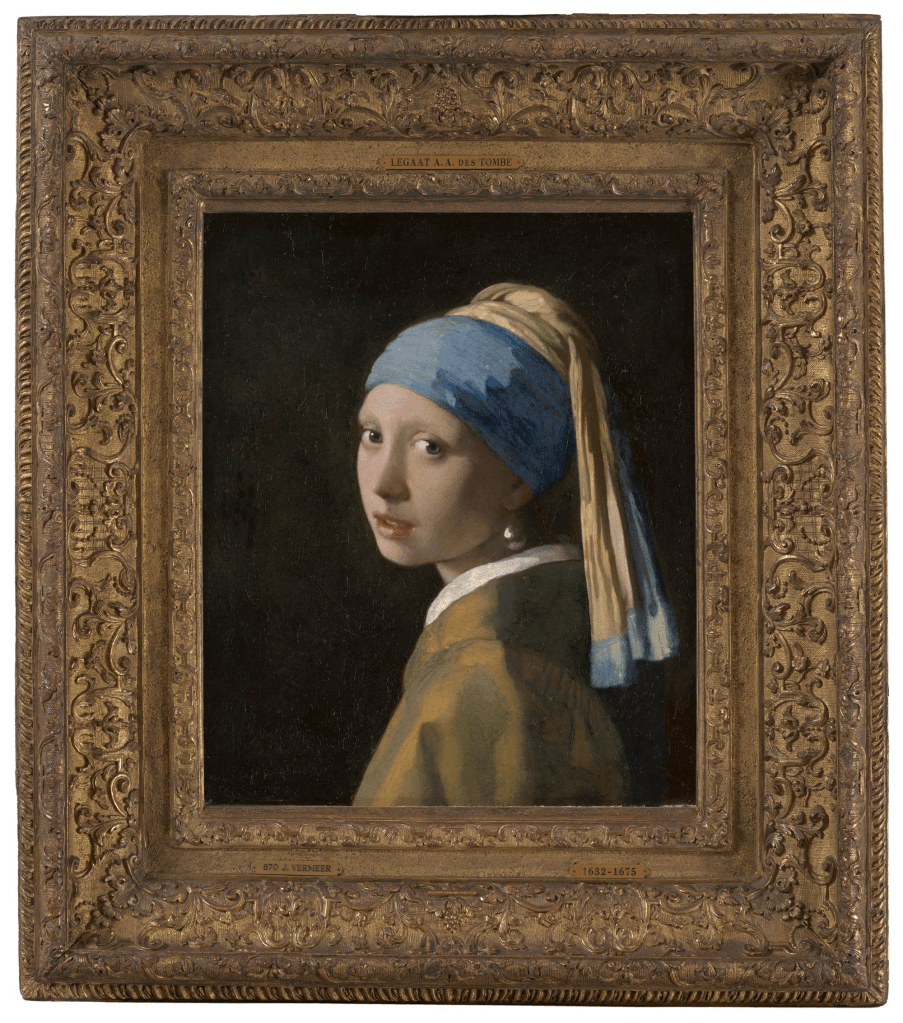
Getting back to the earring girl of Vermeer’s, The Mauritshuis museum in The Hague, which houses this 17th century masterpiece, commissioned neuroscientists to measure brain output when viewing the portrait and other equally famous works of art. They discovered, to their astonishment, that the viewer is held captive by a neurological phenomenon called ‘Sustained Attention Loop’ which they swear blind is unique to Vermeer’s Girl with a Pearl Earring. S.A.L., to coin an acronym, is a state of being whereby the viewer’s eye is automatically drawn first to the girl’s own eye, then down to her mouth, then across to the pearl, then back to the eye – in a continuous loop. Hence the title. Evidently this makes you stare at the painting longer than others, according to the scientists. To quote one of the boffins who has been slaving away at Vermeer’s masterpiece, ‘You have to pay attention whether you want to or not. You have to love her whether you want to or not.’ While I can understand one’s rapid eye movement being controlled by the magnetism of the earring or the girl’s eyes, I did not quite get the love angle. Then again, who am I, a mere bystander, before a master of the palette?
Even without the benefit of these men of science analysing the girl’s earring and our eye movement, I have unfailingly experienced Mona Lisa’s eyes following me when I ogled her from whichever angle in the room I chose to stand and admire Leonardo da Vinci’s most celebrated gift to Paris and the world of art. No one told me there is some deep scientific phenomenon at work here. Truth to tell, I am not alone. Anybody looking at a painted portrait will tell you the eyes of the subject follow you right round the room, which can be a bit unnerving. It is a kind of optical illusion. Play of light, maybe. Who can unravel these mysteries? When it comes to Vermeer, I now know that it was a ‘Sustained Attention Loop’ that I was experiencing. For this enhanced understanding I must thank these neuroscientists who have studied Vermeer’s earring and the girl’s eyes till their eyes popped out. That particular experience cannot be had, by a logical extension, from the Mona Lisa or Whistler’s Mother, Van Gogh’s self-portraits or indeed, from any of Vermeer’s other girls on canvas. Their eyes can roam all they want as you veer from corner to corner of the exhibition hall. The neuroscientists have spoken. Girl with a Pearl Earring bags the Sustained Attention Loop Award. And I am not about to take issue.
Take a bow Johannes Vermeer, wherever you are.

 Suresh's Corner
Good one, Suresh!
LikeLike