Many moons ago, when my parents were based in the Far East, my father would subscribe to the local English newspaper, as it might have been The Straits Times in Singapore or The New Straits Times in Malaya, as it then was. We happened to live in both these countries over a seven-year period during the ’50s before the old man was transferred by the bank he served, to India. As a special treat for us toddlers, he would add on a couple of tabloid comics on Sundays. Beano and Dandy, Nancy and Sluggo, Dennis the Menace; not the celebrated American Hank Ketcham creation but a rowdy, trouble-seeking, spiky-haired alter ego from the United Kingdom; and many more. By an extraordinary coincidence, both the ‘Menace’ versions were first published on March 12, 1951, the respective publishers claiming they had no idea of the birth of the other, identically-named twin. That’s one to go into the venerable Ripley’s Believe it or Not, now brought out annually in book form. Truth to tell, my dad was as big a fan of these ‘funnies’ as we kids were and on Sundays, the clamour over who gets first crack at the comics was palpable.
That brief historical perspective was only to get on to the main subject matter which has been occupying my mind for some time now, namely, the use of many expressions, which are not strictly words, but sharp expletives which have now become a part of our everyday lexicon. The genesis of these non-words could very well have emanated from comic books and cartoon films. Normally, you will not find these ‘words’ in any respectable dictionary, but constant usage and public pressure have given some of them a backdoor entry and legitimacy. The internet search engines, however, are not too fussed about being respectable and are quite happy to include anything someone heard someone else mutter something indecipherable at a public loo. That said, it was those comics that first started this manner of casual talk; at least, that is my impression and I am sticking to it. Our English teachers at school were dead against comics which only made us embrace these picture booklets all the more. With these few words, let me dive in and expound on the raison d’etre of this contemplation.
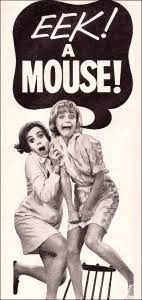
For starters, let us take the word ‘Eek!’ For the purposes of this piece, we shall assume poetic licence and call them words. Ideally, the word should be in italics, but not compulsorily so, followed by an exclamatory mark viz., Eek! For reasons I am yet to fully comprehend, the expression has always been ascribed to the female of the species. For example, ‘Eek! a rat,’ cried Veronica, or ‘Eek! a mouse,’ screamed Betty. The presence of a large bandicoot might have involved a loss of consciousness to the two protagonists. Two points of interest are worth noting from those two outbursts. Archie and Jughead are never called upon to say ‘Eek!’ even if they are petrified of rats and mice. Secondly, the unique honour of exclaiming Eek! has been solely bestowed upon the perceived threat posed by the rodent community. Nobody ever goes, ‘Eek! a python,’ or ‘Eek, a mad elephant on heat.’ In such circumstances, particularly where the male of the species is concerned, the F-word springs to mind. I am too hidebound to spell it out, but Donald Trump had no problem with it in his recent utterances over the Israel-Iran conflict. ‘F#*%! I made Israel and Iran stop the war. Just as I did with India and Pakistan.’ Or words to that effect.
A quick interjection here. These ‘words’ are not to be confused with onomatopoeias, like ‘hiss’ and ‘buzz,’ though it’s a near thing. Then we have ‘Oops!’; another expletive that has no known grammatical provenance but has now gained currency and one which can be employed in different ways at different times. ‘Oops! I am so sorry. I went and spilt the piña colada all over your lovely, Kanjeevaram silk sari.’ The expression is also frequently heard when someone says something he or she should not have uttered, being of a very sensitive or delicate nature. ‘Oops! Did I drop a brick just now, when I described that show-off as a congenital idiot? I had no idea he was the Chief Minister’s son. My bad.’
If you happen to accidentally stub your big toe against the foot of your bed, there is only one thing to be said. ‘Ouch!’ Off-the-cuff, I cannot think of another exclamation that comes anywhere close to ‘Ouch!’ to do full justice to a sudden stab of pain that you had to experience unexpectedly. By definition, this can only apply to minor injuries with no serious consequences barring some passing pain which a rubdown with Iodex can rid you of. Au contraire, if someone bonks you on the head from behind with a sledgehammer, ‘Ouch!’ just won’t cut it. Chances are you will not be able to say anything at all. Again, as I had demonstrated with ‘Oops!’ there is a non-physical aspect to ‘Ouch!’ as well. This too has something to do with causing hurt or embarrassment to another person, but in a metaphorical, read emotional, way. ‘Hi Geetha, lovely running into you like this. Where is that dashing husband of yours?’ Geetha wears a wan look, her eyes welling up and goes, ‘We split up.’ You go blue in the face and mutter, ‘Ouch! Sorry to hear that. Still, as you are here, what can I offer you?’ A weak response, but one makes do.
Then there is ‘Oof!’ Yet another non-verbal response that is called for when you get biffed in the midriff area. This form of injury is more serious than the ‘Ouch!’ infliction but not fatal. Internal injuries are unlikely. You get winded, as you might in a boxing ring when Mike Tyson hones in on your stomach with a left jab with plenty of follow-through. You are left breathless for a while, that is the key to experiencing the ‘Oof effect,’ if you will pardon the coinage. World medical opinion is unanimous in its conclusion that the emanation of the ‘Oof!’ sound is non-serious and can be treated with a few deep breaths, some vigorous toweling and some encouraging words from your boxing coach like ‘Get up and fight you sissy, and make sure your right forearm guards your stomach.’ If the pugilist is a southpaw, you say it the other way round. ‘Seconds out of the ring,’ hollers the referee. Interestingly, unlike some of the other examples, ‘Oof!’ can never be used metaphorically.
‘Ugh!’ nearly always expresses disgust in a nauseating way. If you wake up at the crack of dawn and find that your pet pooch, which is suffering from indigestion has decided to unburden its stomach contents on to your bathroom mat, you instinctively go ‘Ugh! That is if you haven’t unknowingly stepped on the messy stuff, in which case a loud ‘F#*%!’ immediately comes into play, waking up the entire household. Only after that do you weigh in with ‘Bad boy, Paddy, bad boy. No breakfast for you this morning.’ That is perfectly fine with Paddy because he won’t go near his breakfast if you pleaded with him. If Paddy could speak, he is likely to go ‘Ugh!’
‘Yipes!’ and ‘Yikes!’ mean pretty much the same thing, indicating shock and surprise, and not in a very nice way. I suspect these two words came into being to provide boys and men with a suitable riposte to the female ‘Eek!’ which had, as we have demonstrated earlier, cornered the market when the mice came out to play. Our comic books are also quite fond of putting the term ‘Aargh!’ into the mouths of characters who are unpleasantly shocked by grizzly bears blocking their path in the mountain passes of Canada. I am not a great fan of ‘Aargh!’ (or grizzly bears, come to that) but there it is.
As I reach the end of this somewhat unusual perambulation of wordless expletives (and I am sure our readers can add many more of their own favourites), I felt it only right that I provide a couple of examples from India’s own, rich vocabulary of nonsense words. Not being a polyglot, I shall confine myself to just two. As a Tamilian by birth, ‘Ayyayyo!’ is an expression I have been used to since birth. It can mean just about anything. From a painfully disappointed reaction, ‘Ayyayyo! you failed in your exams again?’ to a shocked ‘Ayyayyo! my diamond necklace has been stolen. Call the cops.’ However, my favourite comes from my late grandmother-in-law, ‘Ayyayyo, Gavaskar is out.’ It is a versatile expression and can be used in multiple situations.
I also consider myself an adopted son of Bengal. The claustrophobically bustling city of Calcutta, its ins and outs were my old stomping ground for over three decades. Bengali is a beautiful language though ‘Eesh’ would not have been poet Rabindranath Tagore’s first choice to embellish his sublime poems. Notwithstanding, you will constantly hear this expression, primarily from the girls. The best way I can attempt to define ‘Eesh!’ which has several interpretations is that it is a sound indicating bashfulness, that issues forth when a girl is teased about a crush she is thought to harbour over a screen or cricketing idol; looks taking precedence over prowess. As in ‘Eesh! stop it. He is gross. How can you?’ meaning exactly the opposite. I think you get the drift. ‘The ladies of Calcutta / Do something to me,’ by crooner Bill Forbes played over the sound system, as the pretty ladies from the City of Joy, did the fox-trot with their beaux at the Saturday Club. Did they go ‘Eesh!’ when their partners echoed the singer’s sentiments and whispered sweet nothings into their shell-like ears? You’d be unwise to bet against it.


 Suresh's Corner
You are at the top of your form with this piece, Suresh!👍
LikeLike
Thank you Anjum, as everyone likes to call you.
LikeLike
Gee whiz! What a topic to write about.
LikeLike
Brilliant, Suresh. Worthy of a column in Punch back in the days.
Thank you.
Sachi Mukerji
LikeLike
Thanks to our Clarion McCann days, I was introduced to Punch. It still stands me in good stead. Thank you, Sachi.
LikeLike
Your creative juices appear to be in full flow! As to ‘Eesh!’, I became familiar with the expression only on account of the last retelling of ‘Devdas’. Your brilliant expose has now made the nickel drop, finally!
LikeLike
Thank you. I spent many years in Calcutta. Hence my familiarity with the patois.
LikeLiked by 1 person