What one can be, one must be. Abraham Maslow (1908-1970).
The other day, I was watching some documentary film on Netflix, the name of which escapes me completely for the moment, but there was this professor of psychology from some famous university, never mind from where and his name, who was going on endlessly about Maslow’s Hierarchy of Needs. On the blackboard, a white blackboard (top that for a contradiction in terms), was a triangle with some horizontal lines and other unintelligible stuff chalked (felt-penned) on it. The fact of the matter is I did not even elect to watch this programme. Maslow was a closed book to me as was his hierarchy of needs. What Maslow needs is his business. I had needs of my own to worry about. The fact is, I was hunting for a documentary on rock icon Bruce Springsteen, which had received rave reviews. However, while surfing, this bespectacled, pale, bald grey-suited academic hove into view. There was something compelling about him and I thought, why not I stay with him for a couple of minutes, just to see what he was babbling on about, before moving on to ‘Bruce the Boss’ who was going to explain to his fans why he deeply regretted being Born in the USA. To cut to the chase, I did not get to old Bruce at all. I got stuck with the professor and his theories on old Maslow. He held me in thrall. Let me tell you why.
Before I delve into the details of what Maslow propounded, I wish to make it clear that I had not abandoned the kinetic Springsteen altogether. I was determined to get back to his documentary at a later date. For the nonce however, I had no doubt the American idol had by now satisfied all his hierarchical needs till he was sick to the stomach. And then some. As a normal human being who could actually count how much money he had in the bank (won’t take more than two minutes, tops), I felt I could benefit by paying an attentive ear to what Mr. Abraham Maslow was trying to convey through the medium of this aging, anonymous university professor.
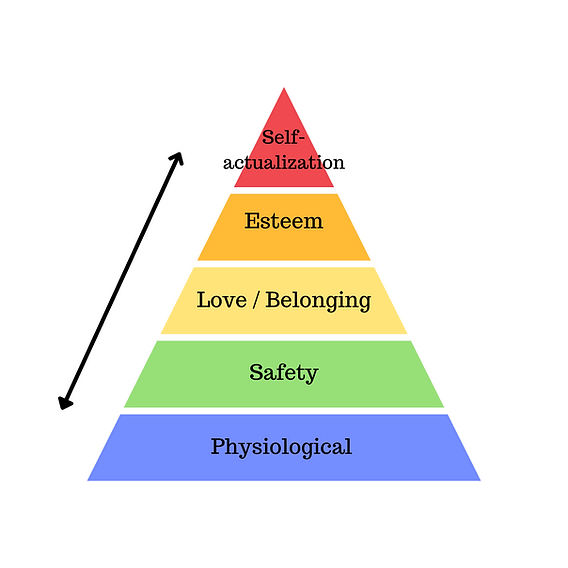
For a common or garden definition of Maslow’s theory, such that simple, unsullied minds like mine can follow it without having to resort to sophisticated search engines, this was the best definition I came across: ‘Maslow’s hierarchy of needs is a motivational theory in psychology comprising a five-tier model of human needs, often depicted as hierarchical levels within a pyramid. Needs lower down in the hierarchy must be satisfied before individuals can attend to needs higher up.’ One thing was clear to me. The pyramid was crucial to our understanding of Maslow’s theory. Without the pyramid, you could be whistling in the dark. Maslow owes a deep debt of gratitude to the ancient Egyptians, and he would have been the first to admit it, had someone bothered to ask him.
The five-tier model that Maslow holds so dear to his heart is key to our understanding of the great man’s theory. What I propose to do now is to go through each tier in brief detail and see where I stack up against them. You can try it yourself, dear reader. If this sounds like one of those Reader’s Digest’s ‘do-it-yourself’ articles pushing self-help and self-actualisation, the resemblance is purely coincidental. I will be speaking only for myself. With these few words.
Topping the charts, I tell a lie, we are starting from the bottom, so it should properly be ‘bottoming’ the charts or bringing up the rear, if you will pardon the expression. The bottom of the pyramid lists Physiological Needs to kick us off on Maslow’s merry, hierarchical jaunt. This involves essential biological requirements such as air, food and sleep, that keep the human body alive. Well, what do you know? What about sex for procreation or sowing one’s wild oats, Mr. Maslow? You left that out. Unless sleep covers that aspect as well. Surely, you are not the squeamish type? After all, long before you Sigmund Freud went on and on about the birds and the bees endlessly. Nevertheless, the human species has added that to the list of Physiological Needs and we haven’t looked back.
Maslow then moves on to Safety Needs. The desire for a predictable and secure life, including protection from danger, financial stability and health. Nowadays, there are those like Elon Musk and Donald Trump who may hold a contrary view, that predictability is passé, and not all that it is cracked up to be. Bring it on Mr. President – 50% tariff yesterday, 25% today, 10% tomorrow (if I am a good boy or if the almighty Supreme Court takes him to the cleaners). Just when you think ‘thank God that is over,’ he is back again, like the proverbial bad penny, with 126% tariff on solar panels! It is like playing Russian Roulette with Trump. Or should that be Putin? No one knows what is coming next, so say goodbye to financial stability which means our health is screwed and danger lurks just around the corner. All of which effectively blows Maslow’s theory out of the water.
Moving up the triangle, Maslow brings us to Love and Belongingness, namely, the emotional need for connection through friendships, intimacy and being part of a supportive group. Aha, so the great man slipped in the intimacy clause here. That’s clever. Sex does raise its ugly head after all, though Maslow is not overly fond of the three-letter word. As for the emotional need for connection through friendships, I have no quarrel with that. What about ‘being part of a supportive group?’ In America, people make millions organising support groups for alcoholics, druggies, sex offenders, broken marriage victims, manic depressives and just plain, run-of-the-mill criminals. In India, our families take care of all that. We don’t believe in paying extortionate sums of money to a shark who asks individuals in a darkened room to stand up, tell everybody else sitting round in a circle what creeps they have been and cry buckets before one of the other creeps puts a sympathetic arm round his shoulder. However, I hold firm in my contention that intimacy, a primordial impulse, and all that it stands for should have, at least in part, featured in the Physiological Needs category.
That hierarchical triangle of Maslow is now narrowing further as we move upwards and arrive at Esteem Needs – which is the pursuit of self-respect and the desire for status, recognition, and appreciation from the people around you. Yes, we have all craved peer group approval on achieving any kind of success, having suffered peer group pressure for long periods of time. Do not believe the recipient of some major award who blubs emotionally in front of his audience, ‘I could not be standing here with this beautiful statuette, without the help of each and every one of you. This belongs to you as much as it does to me.’ Balderdash! Worse than that is the awardee who says, ‘I cannot thank you all individually, but you know who you are.’ Baloney! You wanted it, you got it. You thanked and blew kisses to your beautiful wife, children, housemaid, Spotty the Dalmatian and your driver. Now kiss that statuette for the cameras and put it away in your bank locker for safe keeping.
Finally, Maslow takes us to the very top or tip of his isosceles triangle of hierarchies. Self- Actualisation, or the personal drive to reach your full potential, grow your talents and find true self-fulfilment. This is old hat for most of us in Bharat, that is India. We have been chasing gurus and swamis – some of them genuine and many of them charlatans – hoping to find something beyond our ken, that may or may not be there, a sort of spiritual chimera. In fact, many western celebrities such as The Beatles, Mia Farrow, Leonard Cohen, Allen Ginsberg et al., came to India, ‘seeking the truth.’ Only to discover smoke and mirrors. There is no evidence to suggest they found it, though The Beatles composed some nice songs while they meditated in Rishikesh with the help of the Maharishi Mahesh Yogi, supplemented by some uplifting weed and other banned substances! Then you realise you’re only very small, and life goes on within you and without you, the late Beatle George Harrison was moved to sing, in the raga Khamaj, with sitar, dilruba and tabla, sitting cross-legged in front of the Maharishi. Another guru, Acharya Rajneesh a.k.a. Osho, advocated the Kama Sutra route to salvation, but we will put that to one side for now. So, thanks Mr. Maslow but no thanks. When it comes to Self-Actualisation, we Indians are in a league of our own.
Now that I am done triangulating Abe Maslow’s theory of hierarchical needs, am I any the wiser? Sounds pretty basic to me, his theory. Perhaps therein lies the secret: his ability to make complex principles sound simple. Tell you what, I shall conclude this contemplation with my own take on a man who has been greatly vilified – Epstein. A man whose wants and needs, hierarchical or otherwise, knew no limits. However, I am fully on his side. Go on reader, mock me. Vilify me. O ye of little faith! Without Brian Epstein, we would have been deprived of The Beatles, which is almost tantamount to the end of the world, at least for some of us pimply, adolescents growing up in the 60s. Sadly, he took his own life and we shall never know why. Did someone say Jeffrey Epstein? Dear me, we have been at cross purposes. You mean the bloke who allegedly hanged himself in jail? Or was he mugged to death? The CCTV cameras conveniently went on the blink. Who knows? Who cares, other than Donald Trump, Bill Clinton, Bill Gates, Prince Andrew and a host of other celebs?
All said and done, it’s been A Hard Day’s Night doing this piece. Thank you, Abraham Maslow.


 Suresh's Corner
Nice piece , Suresh!
LikeLike
Re- learning Maslow’s theory after years of teaching it was great. Next in the se.ries should be Six Sigma!
LikeLike
Re- learning Maslow’s theory after years of teaching it was great. Next in the se.ries should be Six Sigma!
LikeLike
Dear Suresh ji, I tried to post my comment Via your agency but not sure if it went through. Therfore I am sending herewith the same Re- learning Maslow’s theory after years of teaching it was great. Next to expect from you is Six Sigma ! Regards Raman
LikeLike