Uncle Sam drops a few bricks

Sam Pitroda reflects. What have I gone and done?

Almost seven decades ago, 68 years to be precise, the wondrous Harry Belafonte, now sadly no longer with us, released a melodious, calypso-tinged song called Brown Skin Girl (stay home and mind baby). We teenagers at the time had no clue that this was a song that lyrically satirised and obliquely commented on American soldiers who landed in Jamaica and other islands in the Caribbean (ostensibly to protect the local yokels from a fate worse than death). Only, as they have routinely done in various parts of the world, the Yanks left the islands leaving a bevy of (mostly) blue-eyed babies, who will never know their fathers. The sordid import of those lyrics we only learnt much later. The song itself was catchy and hummable, and along with many other such songs like The Banana Boat Song, Harry Belafonte became a party favourite all over the world. A quick warning. If, upon reading this, you happen to search Brown Skin Girl on the internet, you will get something unlistenable (my personal view) by Beyonce with some rappers called Blue Ivy, Wizkid and SAINt JHN (sic). Avoid at all costs. Be sure to key in Harry Belafonte after or before the song title. Finding something of good taste involves a hard search – needle in a haystack.

Now what made me think of Belafonte and Brown Skin Girl, you are doubtless wondering. No prizes for guessing. A gentleman by the name of Sam Pitroda, till recently friend, philosopher and guide to the Congress Party of India and in particular, Uncle Sam to the Gandhi clan (count from Rajiv Gandhi downwards), decided to shoot his mouth off on the racial diversity of India – not in a very clever or avuncular way. So far, so bad. Pitroda’s defence, if he had one, was that he was celebrating the diversity that is Bharat that is India. Nice try, Sir. To be fair to the man, not that I am in any mood to be, he may have been taken somewhat out of context, though there were not many takers for that school of thought.

Which is hardly surprising. Mr. Pitroda went about it so ham-handedly that he has now been ostracized, officially declared an outcast and forced to resign from his role as Chairman of the Indian Overseas Congress. I was not even aware that such a body existed. Try these on for size as the man extends himself in a Joycean, stream of consciousness vein. Likening people from the East of India to the Chinese (broody herr!), denizens from the South to Africans (Crikey! / Ayyayyo!), those from the North to the whites (really? Caucasian?) and pretty much the rest of the country to the Arabs (enough to give you the sheikhs). All this purely on the basis of skin tone. Clearly, Pitroda’s mouth started operating on fifth gear while his brain was still cranking up to second gear. He was gassing away on the fly. Result? A potential political disaster for the Congress just when they were beginning to gain some traction leading up to the final stages of India’s general election. At this time, they needed Pitroda’s gaffe like a hole in the head. Before I go on in this vein, let us acknowledge that Sam Pitroda it was, who led the telecom revolution in India during the early 90s. You can’t take that away from him, though that does not give him the licence to start racially equating Indians with Chinese, Africans, Arabs and Whites.

While the Congress Party wasted no time, to their credit, in distancing themselves from Pitroda’s blooper, the BJP went gleefully on overdrive to take full advantage of what was clearly viewed as an unpardonable solecism on the opposition’s (read Sam Pitroda’s) part. It is election time, after all, and the BJP minions were in no mood to look a gift horse in the mouth. The Prime Minister, as is his wont, thundered on about how cross he was at this gross insult to India’s people. Speaking for himself, he would not have minded barbs being directed at him as he is quite accustomed to it. ‘Sticks and stones may break my bones, but words can never hurt me,’ he seemed to be saying. However, he drew the line at this tasteless slur on his beloved countrymen, women and children.

Quite right, too. He demanded an apology from the Congress apparatchik over this racial brick dropped by Sam the Sudden, but thus far no apology has been forthcoming. Surely, his banishment from the party should be apology enough? Other leaders from the BJP wasted little time in hurling vituperation at their opponents. In for a penny, in for a pound. My favourite sound byte came from Assam’s feisty Chief Minister, Himanta Biswa Sarma who said, ‘After I heard Sam Pitroda’s statement, I looked at myself in the mirror and I appear as a proud Assamese and Indian, not as a Chinese… this is a racist comment.’ It is noteworthy that the CM of Assam needed to stand in front of his dressing room mirror to ensure he is in no way, shape or form a man of Chinese origin. Must have come as a huge relief to him. Still and all, better safe than sorry, I suppose.

Is anyone feeling sorry for this Pitroda chap? He has obviously jetted off to some distant island in the West Indies to reflect on his faux pas and to nurse his wounds amongst the blue sea and silvery sands. With plenty of coconut water to wash down the fried onion bhajjis. Yes, you can get them in those islands. I am guessing Sam is a vegetarian, given his Gujarati background.  All that is just speculation on my part. For all I know, he could still be in touch with ‘the family’ sending priceless advice by code. He is a techie, after all. Who knows? Strange name, Pitroda. Never met anyone else with that moniker. As I suggested earlier, I am told his antecedents come from Gujarat, the land of THE Gandhi, that is the Mahatma, and, of course, our Prime Minister, THE Modi. There’s a dollop of irony for you. Whether Pitroda’s forbears can be traced back even further to Africa or China is anybody’s guess. As all of us humans have descended from primates, I do believe Pitroda’s critics might be going a mite over the top, but then, that is politics, baby. God knows, he fired the first salvo. Unwisely. Now he has no option but to face the music.

Since Sam started all this colour coding business, I have been struck by one anomaly pertaining to his head and facial hirsuteness. Why is his head of hair a mixture of grey and white, while his goatee beard is unfailingly jet black? Bears thinking about. While how he wishes to look when he confronts his mirror is entirely his business, I would strongly advise him to dye it all black, or leave the external grey follicles to their own, natural devices. Seeing as the grey matter inside his head is being severely challenged, given his recent pronouncements, that may be his best course of action. I am not sure if Sam Pitroda is familiar with the works of the late Frank Sinatra, aka, ‘Ol’ Blue Eyes. If he is, he might reflect ruefully on the lyrics of this hit song, Something Stupid, which Frank duetted with his daughter, Nancy.  I practice every day / To find some clever lines to say / To make the meaning come true / And then I go and spoil it all by saying something stupid like……

Dear reader, you can paraphrase the last words of the incomplete line, as the fancy takes you. Just make sure it rhymes.
When old boxwallahs pick up the pieces

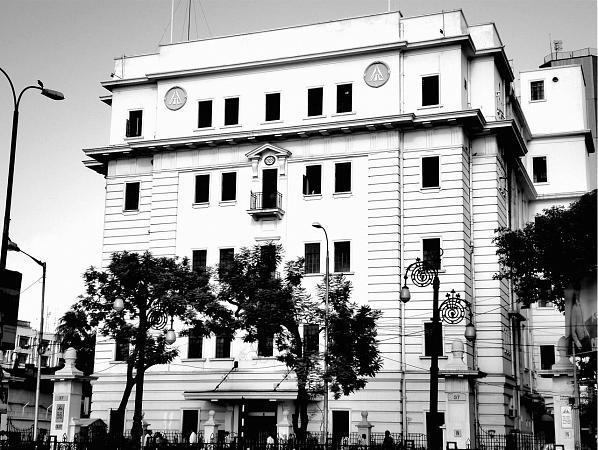
Imposing facade of ITC’s Virginia House, Calcutta

Ever since I can recall, I have never been much of a political person. For the purposes of this essay, I am not talking about petty office politics (the proverbial gossip at the water cooler) or even more petty family politics, but the national political scene – the biggie. With elections well and truly upon us, what else could it be? For myself, I lean neither to the left, nor to the right. My school motto was ‘On Straight On!’ which explains my somewhat ambivalent position on the issue of taking a political stance. I believe the proper term to describe such an individual is apolitical. Which reads like a spelling error, but there it is. The naysayers might characterise such a stance as akin to one ‘sitting on the fence.’

That is all very well, but in this day and age, and given my age, it becomes very hard to sit quietly in mixed company, sipping my fruit cocktail and declare that I am not in the least bit interested in politics. Fifty years ago, I could have done that with impunity. Congress, BJP? Who dat?  An indifferent shrug of the shoulders, while I whistle Raindrops Keep Falling on my Head in a distracted manner. Right now, I should be so lucky! With the raindrops, I mean. Rain man, where are you? To get back to the subject on hand, I was not an uninterested animal when it came to politics, more disinterested, if you get my meaning. I could not have cared less, one way or the other. I was not ideologically driven. Make of that what you will.

All that has changed. It matters not a whit who you are spending an idle hour with these days. Your own kith and kin, close friends, strangers whom you may have just run into while waiting for your flight to be announced – you simply have to mind your political Ps and Qs. I was recently embroiled in one such situation, when I ran into an old acquaintance from my university days. While I cannot claim that we were bosom pals, we certainly belonged to a group that nursed pretensions towards the finer aspects of art, literature and music.

This person, of whom I speak, was one of those who invariably saw himself as something distinctly apart from the rest of us. Bit of an effete snob, a pain in the nether regions, but truth to tell, that was the case with most of us at college. A clear case of the pot calling the kettle black. Ostentatiously displaying J.D. Salinger’s The Catcher in the Rye and Jack Kerouac’s The Dharma Bums, these rubbing shoulders with our armful of text and exercise books. Humming Don McLean’s American Pie to casually impress the girls. The ubiquitous packet of Charms (or something even more mood-enhancing) being passed around the while.

Still and all, we were good friends, frequently seen to be plucking the gowans fine, to draw on an ancient aphorism. I did warn you that we were a sickeningly pretentious lot. For the record, I understand the expression has P.G. Wodehouse’s imprimatur and no one else has laid claims to it. Do I hear you ask, ‘What does it mean, plucking the gowans fine?’ I shan’t spoon feed you. Look it up, like I did. Putting all that to one side, this character from the dim mists of time started chatting with me, and our conversation went roughly along the following lines. Being sensitive to his feelings, I shall employ a nom de plume and call him Montu, a name not calculated to raise exalted visions of a litterateur, but Bengalis (I grew up in Calcutta) loved names like that. Pintu would have done equally well. Not being a natural-born Bengali I, perforce, will be referred to in the first-person singular. No name, no pack drill.

‘I say Montu, my old friend, how’s tricks? All going well?’ Seeing as I had not met him in years, I thought the hail-fellow-well-met approach would hit just the right spot. ‘Flying to Calcutta?’

‘My dear fellow, we are both sitting at the same gate awaiting the boarding call to Calcutta. Where else would I be flying to? I should be grateful you didn’t ask me that after the plane took off.’

I guess I asked for that. ‘Montu at your sardonic best, I see. Just making conversation. Something to break the ice. Anyhow, it’s been ages since we last bumped into each other. What are you up to these days? Last I heard, you were heading up the HR function at ITC or Shaw Wallace or some such, weren’t you?’

‘If you must know, it was Metal Box. They called us boxwallahs for a reason. In fact, pardon my showing off, Nobel Laureate V.S. Naipaul made reference to “the boxwallah culture of Calcutta” in one of his novels. All that is so much water under the bridge. We are both retired from corporate service. I remember you in Dunlop putting out all those clever advertisements. At least you seemed to be having a bit of fun. In HR, all we ever did was figuring out ways to sack staff.’

‘Oh come, come, surely it was not all that dreary. I know it was impossible to sack unionised labour, particularly in red-flagged Calcutta those days, but managerial staff was fair game, were they not? And there were all those bright, young lady secretaries to brighten up your day.’

‘As was the case in your company as well, but things started to change as you know. What with advanced computers and rapid changes in technology, the office secretaries were rendered hors de combat. An endangered, if not extinct, species.’

We then went on to chat a bit about how we missed the Calcutta club culture, decadent as it was, but the hooch was cheap. I had just taken the conversation to a higher plane with casual references to Satyajit Ray, Mrinal Sen, Ingmar Bergman, Jean-Luc Goddard, Miloš Forman and others of that ilk. Just then the ‘higher plane’ took a nose dive as our own flight to the City of Joy was announced. As we got up to join the queue to the bus, I put it to Montu that we could quaff a beer at The Saturday Club at a time of mutual convenience. ‘For old times’ sake?’ I added for good measure. ‘I don’t think so,’ was Montu’s lugubrious response. ‘I have had my fill of Calcutta’s musty clubs. The rats are feasting on the carpets. Trying to recapture the past is a mug’s game. If it’s all the same to you, I shall give it a miss.’ So saying, he wandered off towards the jam-packed bus that would ferry us to the plane. A sad, forlorn figure.

I decided to let Montu board well ahead of me and hoped we were not seated within coughing distance of each other in the aircraft. A pity, because I was about to engage him in a bit of political chinwag. You know, stuff like how is our old friend, quizmaster extraordinaire -turned feisty politician Derek O’Brien getting along with Mamata Di? A far cry from the days when we worked closely with him at sponsored quiz programmes at The Dalhousie Institute Club. All that will have to wait for another day. Or perhaps, another echo from the hoary past that was Calcutta née Kolkata- a Jiltu, a Khokhon or even a Bapi. I had given up the ghost on Montu. At least in those days, we fought over film directors, cricketers, authors and musicians. We did not care two hoots which party ruled the country or the state. Why the indifference? Elementary, my dear you-know-who. My father, who art in heaven, paid for everything and petrol retailed at a rupee a litre. We were young, impressionable idealists, dreaming of Oxbridge and Harvard, who could afford to give politics and politicians the good, old heave-ho.

Dear reader, if you heard a deep, nostalgic sigh, that was me.

    Stone walls do not a prison make

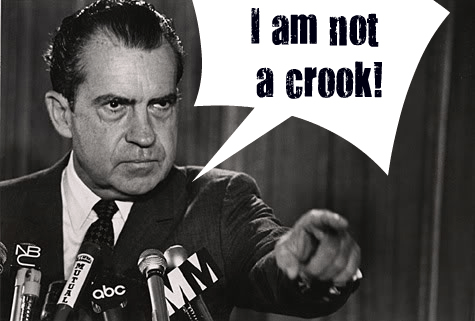
President Richard Nixon’s (in)famous quote

I have a question that has stayed with me for more years than I care to remember. Why is it that whenever a politician, industrialist, film star or some other big wig is taken into custody by the long arm of the law, the arrested individual invariably sports a triumphant smile for the cameras? Not to forget the thumbs up signal for the world to witness and conclude that they are completely innocent, pure as the driven snow. It is as if the alleged criminal has just won the biggest lottery of his life or been declared winner at the general elections from his constituency. In a sense, they are both more-or-less the same thing. By which I mean that politics is a lottery, and by recent accounts, those who run lotteries are inextricably linked with political parties. The only exception to this rule is when the persons or gangs so incarcerated have been accused of committing a ghastly murder or rape, they are all tied together like so many lambs being taken to the abattoir, their faces covered with a black mask – the criminals’ faces I mean, not the lambs’. Which is a big let-down for television viewers, who would love to wallow in their schadenfreude and get a close look at these fiends in human shape.

Part of the reason why many of these alleged criminals display that ‘all is for the best in the best of all possible worlds’ look is sheer bravado, intended solely for the cameras. Then there is what can only be described as the burning martyr syndrome. Playing the victim card. Former President of the United States, Richard Nixon, while deeply embroiled in the Watergate scandal, famously said, ‘I am not a crook.’ Case closed. In the event, the courts opined differently and Tricky Dick had to hightail it out of the White House. The justice system in the United States makes no distinction between the high and mighty and those less privileged. Retribution is swift. Here in India, things take their own, majestic course. As we speak, AAP chief and Delhi Chief Minister Arvind Kejriwal is cooling his heels, along with some of his senior party colleagues in a prison cell, the courts clearly looking askance at his bail application. As this piece goes to press, one of them (not the CM) has just obtained bail.

This has provided a heaven-sent opportunity for the fractured opposition INDI Alliance to apply Fevicol or some other adhesive substance to glue themselves together, albeit temporarily, and vent their spleen against the ruling dispensation. Once the general elections get under way, they can get back to squabbling among themselves. It is noteworthy that the wives of leaders such as Kejriwal and Hemant Soren have been pitchforked into the melee to make emotional appeals to the public, shedding crocodile tears while bemoaning their pitiable plight. It must be hard for prominent politicians’ families to run the household while their husbands are forced to practice yoga in dank cells. One’s heart goes out to them. However, from the point of view of gaining brownie points prior to the elections, it may not be the worst ploy to unleash the victims’ family members to tug at the heartstrings of an impressionable public. Accordingly, the opposition parties got together in the capital and their leaders shook their fists and railed against the government in power.

Rahul Gandhi, in a rare turn of inspiration, likened the government to ‘match fixers.’ He employed the match fixing theme as a telling idiom and warned the public of dire consequences if they were dumb enough to vote the BJP and its allies back to power. The Gandhi scion literally shouted himself hoarse. His voice would have been a non-starter in any singing competition, though he sounded a lot like Louis ‘Satchmo’ Armstrong with a sore throat. Whether Rahul Gandhi can hold a note or not is a moot point. If I were him, I would be more concerned about a few black sheep in his own alliance, as opposed to going baa-baa at the BJP, whose antics he must by now be fully familiar with.

Members of the ruling party, meanwhile, are sitting back and purring contentedly like the proverbial cat that has had its saucerful of milk. They have already decided that their war cry, Ab ki baar, char sau paar is a foregone conclusion. Done and dusted. They may not have heard of the axiom pertaining to the perils of counting one’s chickens before they are hatched, but they would do well to pay heed. Hubris is a dangerous affliction and some of their recent actions may come back to haunt them. The awkward question as to why only opposition party members are routinely rounded up on some allegation or the other, and none from the ruling classes sticks out like a sore thumb. The standard response is that if you find any misdeed with any of their members, file a complaint with the police. Hmmm.

The opposition parties keep coming up with the ‘washing machine’ analogy. The theory being that if you have had a shady past, all you have to do is ditch your party and join the treasury benches. Just say the word and all your past sins will vanish in a trice. Spotlessly white. You don’t even need Surf Excel. The ruling party’s rejoinder is that the opposition can always approach the courts for redress. Thus far the courts have taken a leaf out of Queen Victoria’s line, ‘We are not amused.’ One thing we know for sure. The rival political spokespersons can go hammer and tongs at each other, but no one will dare speak pejoratively of the judiciary, if they know which side their bread is buttered on. ED, IT, CBI, CEC – all fair game to aim pot shots at, but not a whimper against the judges. Rahul Gandhi has just said the country ‘will be on fire’ if the BJP is returned to power. To which the PM has riposted by asking Indians to wipe out the Congress from every nook and cranny of the country. Let battle be truly joined.

 And to those who are chalk-marking their days in incarceration, they can take solace from the poet’s lines, ‘Stone walls do not a prison make, nor iron bars a cage.’ While you are at it, mind that triumphant smile does not turn into a frozen rictus.

The Eyes have it

I am not sure what it is, something in the air perhaps, but every other person I know seems to be going in for cataract surgery. This awareness has been brought sharply to my attention when, after a routine eye check-up, my ophthalmologist declared that I am a ripe candidate for the removal of my cataract in both eyes before they ripen any further. As some poet, whose name escapes me for the nonce said, ‘The time is ripe, and rotten-ripe for change.’ A date was set and I began to embark on the inevitable Google search to learn all about cataract surgery, its benefits and risks, at the end of which I was not sure if my eyesight will return to its pristine 20/20 vision status, or if I will turn completely blind. I have warned some of my closest friends and relatives never to conduct internet searches relating to one’s medical issues. That way lies the path to prolonged uncertainty and misery. In the event, I did not heed my own counsel, and had to spend a few weeks in speculating on all manner of post-surgery complications that were a product of the wretched Google and my own fertile imagination.

However, as I had indicated at the top of this piece, I was in good company. Unbeknownst to me, my brother in Chennai was about to have his eyes operated upon for cataract. The same went for two of my cousins and three close friends, some of them living abroad. We came within a toucher of forming a WhatsApp group, we ‘Cataractees,’ if you will pardon the coinage. That is the way to go nowadays in our digital world. We could have daily, if not hourly, exchanged messages on symptoms, our doctors’ relative competence, eyedrop routines, insurance issues, post-op adjustments and so on. Thankfully, wiser counsel prevailed and we threw the idea out of the window. Nevertheless, well-meaning advice was given and received with gratitude, even if such advice was gratuitous. One of my close friends, claimed he saw pink immediately after the surgery. ‘Everything looked alarmingly pink for a couple of days,’ he exclaimed, ‘was I turning colour blind?’ Surely not, if he could see pink. I don’t know about pink, but he must have seen red vis-à-vis his surgeon. Happily, his pink phase passed and his sight returned to normal, and his eyes are now in the pink of health. That was good news for my friend, but as I was about to submit myself to the surgeon’s knife (or laser), it gave me pause.

Speaking of being alarmist, I had to take a fitness certificate from my GP, based on a routine ECG and blood test, this to be submitted to the hospital before my eye doctor would agree to undertake the surgery. I expected this to be a cakewalk, but my GP saw something in my ECG report that I did not. ‘I don’t like this,’ he said gravely, looking at one of the snaky squiggles that typically turn up on an ECG graph, if graph is what it is. He then proceeded to write a diabolical, lengthy, hand-written report, which virtually said I undertake this procedure at my own risk. I then did what any sensible person would have done. Went to another diagnostic centre and had a fresh ECG done. Lo and behold, this time it came out clear and unblemished. My heart was in the right place, after all. The doctor at the diagnostic centre gave me a clean bill of health and I was on my way. Moral of the story – always take a second opinion.

D-Day arrived and I reported, as directed, promptly at 8.30 in the morning at the hospital for the procedure. This, after two postponements due to some technical issues pertaining to the condition of my eyes and their readiness for surgery. As to what those technical issues were is not pertinent. Suffice it to say the postponements only increased my suspense and gave full rein to my already galloping imagination. Prior to that, I had to be administered 13 eyedrops for a day to ward off infection preparatory to the rigours of the surgery. The person to suffer more was my wife, who had to do the drop administering throughout the day. All I had to do was lie supine, stock-still and look up. Every speck of dust and strand of cobweb on my ceiling fan is indelibly embedded in my memory. Little was I to know that this was just the beginning of the ordeal which, post-surgery would continue for the best part of three months. Drop, drop, drop five or six times a day. A bit like Chinese torture – for the dropper and the dropee.

The rigmarole involved with the surgery itself is interesting. You are first escorted into an ante-chamber, there to recline in a plush leatherette arm-chair, along with six other patients who are awaiting the procedure. Only then do you realise that you are in an assembly line queue. While seated comfortably on these recliners, which remind you of business class travel on an international flight (not that I have had much experience of that), having changed into the customary green smock with matching head-gear, the nurses come round and take your blood pressure, check your pulse rate, administer more eye drops, ask you nicely if you would like some water to drink. They are stone deaf to requests for café latte. You then wait and look around at the other patients, who appear to be in dreamland. A gentleman next to me opened a conversation on the subject of Calcutta, in Bengali! On inquiring how he divined that I knew Bengali, he smiled and said that he heard me talking to my wife in Bengali earlier. For the record, neither my wife nor I are Bengalis but we spent half our lives in Calcutta and there’s no getting away from giving speech in that lovely language. Khoob bhaalo laagche!

At last, your name is called and you are escorted into the OT, which looks more like something out of a sci-fi movie. The sound system was softly playing some old Kishore Kumar / Asha Bhosle duet, Aankhon aankhon mein, baat hone do. Very apt. You are not given much time to take in the scene, as it were. All I saw was a bank of digital screens blinking away to kingdom come. Before you can say glaucoma, you are strapped to a narrow, cushioned plank, all manner of paraphernalia strapped on to you, and more and more anaesthetic drops wash over your eyes. I should properly say eye, because the procedure involved back-to-back surgeries for the left and right eye one day after the other. Anyhow, my surgeon comfortingly tells me I will feel nothing and it will all be over in 20 minutes. She was right. I felt nothing, but I saw stars. Not metaphorically but literally. All manner of coloured lights and shapes, flashing like streaks of lightning and my surgeon periodically asking me how I was feeling. I asked her, besides the eye drops, if I had ingested LSD! That is how crazy and colourful the ‘trip’ was. She laughed heartily, saying nobody had told her that before and if I had indeed dropped acid anytime in my life. I said ‘yes,’ once during my, carefree college days while grooving to The Allman Brothers Band or maybe, Grateful Dead. Some conversation to have during surgery! My whole conception of a surgeon underwent a sea change. Next thing I knew, it was all over and they had slapped a plastic cup and bandaged it over my left eye.

‘Well done,’ said my surgeon, cheerful as ever, as if I had anything to do with it. ‘See you again tomorrow for the right eye.’ ‘You’ve got yourself a date, Doc,’ said I. Come to think of it, it wasn’t such an ordeal after all. My surgeon kept up a steady stream of cheerful banter which kept me in good spirits. The whole procedure was repeated the following day. Two days later, I was looking at the world anew, with two bright new eyes. And I am not seeing pink. Or red. What is more, surprise, surprise, the insurance chaps gave me no trouble and the entire cost of the operation was taken care of in a jiffy. Sometimes, life can be a breeze. Finally, as the nurses were not obliging, on my way out I bought myself a delicious cup of hot chocolate at the swank branded franchise in the hospital foyer.

As we got into the car, I was feeling quite chuffed, though my wife bore a grim visage. ‘What’s up? Everything went well. Why the long face?’ Her response was telling. ‘I am thinking about the post-op drops I will have to administer for the next three months. About 750 of them. That’s why the long face.’

Clearly, she had the drop on me.

Cashless in la-la land

‘He lends out money gratis and brings down the rate of usance here with us in Venice.’ Shylock, Merchant of Venice.

Most of us have credit and debit cards these days, tucked away in slits in our bulging wallets and squeezed into our back pockets. Not to mention driving license, Aadhaar card, medical insurance card and all things plastic, contributing to the battle of the bulge. Hard cash plays a minor walk-on part, if that. Credit and debit cards are essentially the same things, only the credit cards take a while longer to inflict the pain on your bank balance, but that is compensated by their charging a punitive interest rate. You know what they say. There is no such thing as a free lunch. Debit cards, however, are more direct. Swipe one of those and it is bye-bye moolah. Hasta la vista.  These cards are linked to our bank accounts and one’s credit card brand could be any one of the well-known names like Mastercard, Visa, American Express and a host of others. In addition to these cards, various online vendors like Amazon, Flipkart, Big Basket et al, from whom we place orders on a regular basis, entice and exhort us to deposit varying sums of money in their ‘wallets,’ the easier to place orders online without having to go to the trouble of credit / debit card rigmaroles like keeping an eye on the expiry dates, the monthly limits, mad rush to key in the OTP and so on. Forgive me, dear reader, if I am preaching to the converted. Are these the ‘plastic revolutionaries’ that poets and songwriters of yesteryear wrote so presciently about?

Lest we forget, there are also various UPI digital payment options like BHIM, Google Pay, Phone Pe, Pay Pal and Paytm amongst others. The embattled Paytm is currently in strife and under the scanner while we poor sods are still trying to figure out the implications. Meanwhile their chief executive has been shown the door and those of us who have placed our trust and money in Paytm are left wondering if we have not been taken for a right royal ride. Welcome to the rarefied world of cashless transactions. It is by now a well-worn cliché that our next-door dhobi or vegetable vendor transacts business digitally. Dystopian fancy conjures up images of women giving birth to babies, the mobile phone firmly in the clutches of the baby’s hand showing up first out of the womb followed by the parent body. ‘It’s an iPhone 15 Pro Max 256 GB,’ cries the proud father, as he hands out the customary celebratory cigars to his friends. Make that laddoos, if you are a non-smoker.

A brief aside. In the world of trading and commerce, the word cashback is intriguing. I am struck by the word cashback that has now become an integral part of our commercial lexicon. For reasons I have not been entirely able to fathom, the word discount has been cast into outer darkness. Totally discounted. The nobs tell us there is a subtle difference between the two terms, but I am still trying to get my head around it. The only plausible reason I can come up with for this change of terminology is that the word cashback sounds so much more alluring. It is only a mirage of course, but one gets the idea that the company is doling back cash to us every time we buy something. In a sense they do, but only after hiking up their recommended list price. And when we are not actually forking out hard currency from our wallets to pay but swiping plastic cards, or placing our mobiles in front of obliging QR codes, life seems to be a breeze. What you don’t know does not hurt you. Until you check your bank balance at the end of the month. Many people do not even do that. If they do, they flinch and quickly avert their eyes. ‘I couldn’t possibly have spent that much.’ Tell that to the Marines.

There is a deeper question to be addressed. Is the ease of transacting business through credit or debit cards, digital wallets, QR codes and in the case of larger amounts, NEFT / RTGS and so on goading us to spend more than we might normally have done? In other words, are we often buying things we do not really need? There’s a silly question for you during this silly season. Purely rhetorical, don’t bother answering. I know for a fact that every time I visit Amazon with something particular in mind to buy, other products slyly insinuate themselves and proffer attractive offers and you are that sucker that is born every minute, in the immortal words of P.T. Barnum. Rather like Eve in the Garden of Eden seductively reeling Adam in to bite into the apple, giving birth to the original sin.

‘Based on your recent buying patterns, we think you might be interested in these products.’ That is a dead giveaway. If you pay heed, on your head (or bank account) be it. A slew of items will stream in front of your eyes and before you can say ‘two for the price of one,’ you have just tapped a few keys on your mobile phone and bought four printing ink cartridges which you may not use for the next four months, by which time they would not be fit for purpose. Same day delivery of course, which is unfailingly the clincher. They call it bundling. I recently bought the redoubtable and feisty Congressman Mani Shankar Aiyar’s autobiographical peregrinations, Memoirs of a Maverick (the first of a trilogy, not clear if the other two are in the market or on the anvil), online from Amazon.  Just to avoid confusion, my searches revealed there are half a dozen other published books titled, ‘Memoirs of a Maverick,’ with slight variations. That said, they are all foreign mavericks, as opposed to our very own desi variant. For reasons best known to themselves, Aiyar’s book had been bundled with another title, Dethroned, by one John Zubrzycki. If I had not been sharp about it, I would have had two books for the price of two! What is more, I never buy books written by authors whose names I cannot pronounce, which rules out most Polish writers. However, each to his or her own. If you wish to try out Nobel Prize awardee Wislawa Szymborska, Henryk Sienkiewicz or Olga Tokarczuk for size, be my guest and have the time of your life. And mind you don’t get your tongue in a twist.

There you are. The wonders of free-form writing. Stream of consciousness, some may call it. Psychologist William James called it exactly that in 1893 and it stuck. For myself, I just meander, as the mood takes me. I started off talking about cashbacks and discounts and ended up quoting obscure psychologists. Obscure for me, that is. I am sure William James was the toast of his intellectual circle and a household name way back when. Particularly around the pubs in Warsaw. Had I run into the great man, which I could not have on account of my having been born 100 years later (give or take), I would have doffed my hat to him. Had I been wearing a hat that is, which I never have. Then again, should I have met him in some third dimension, having cast off my mortal coil, I would have probed him closely about cashbacks and discounts, to say nothing of UPIs, thereby hoping to stymie him. Chances are, the celebrated psychologist would have responded with some such nugget as, ‘A difference which makes no difference is no difference at all.’ Pithily put. In fact, that priceless gem has been attributed to William James, Esq. Somebody once said, ‘Procrastination is like a credit card: it’s a lot of fun until you get the bill.’ That pretty much sums up my thoughts on cashbacks and discounts.

  Forty winks with my doctor

Hamlet – could never get a good night’s sleep

Some people talk in their sleep. Lecturers talk while other people sleep. Albert Camus.

I was at my general physician’s chamber a few days ago for a routine check-up. I had my latest blood reports, ECG, chest and spine X-rays at the ready. He waded through them perfunctorily, as doctors are wont to do, intoning a ‘Hmmm’ and an ‘Aaah’ or a ‘Tsk, tsk’ now and then. He would also squiggle some unintelligible markings on the pages (another fad of doctors), while you watched silently and a tad apprehensively. Then he views the ECG and mutters something that sounds like ‘arrythmia,’ but as he is muttering to himself, I am still unable to get a word in edgeways. A man of few words, my doctor, playing his cards close to his chest.  Finally, he slots the chest and spine X-rays on to a wall-mounted light box and stares at them for what seems an eternity. I too keep him company and gape at the grey images with no idea of what I am looking at, my pulse starting to elevate by now at an alarming rate. If only the man would say something.

At last, he is done and I wait for his pronouncement. Instead, he asks me a question.

‘Are you in the habit of sleepwalking at night?’

I thought that was a silly question, as if anyone sleepwalks during the day. How could I possibly know if I am in the habit of sleepwalking if, by definition, I cannot be aware of such nocturnal perambulations? Then again, he is the doctor so I had better attempt an answer.

‘I could not possibly say, doctor. If I am walking while sleeping, then I am not aware of it. Stands to reason.’ I thought I had made a good point, but doctors are made of sterner stuff. He was not to be deterred.

‘Surely, your wife would have noticed,’ he said.

‘In the dead of night? She herself would be deeply resting in the Land of Nod. Even if she had been awake, they say you should not wake up a sleepwalker as things could turn ugly. She could alert me the following morning, but as I have heard nothing from her, the sleepwalking theory can be put to bed. Unless, of course, she was also sleepwalking. Then we are in big trouble.’

‘You don’t suffer from sleep apnea, then.’

‘Is that a question or a diagnostic statement? I don’t even know what apnea means.’

‘Never mind. What about getting up in the middle of the night to do your small job? All elderly people go through this nuisance.’ The doctor was clearly adamant. He was pursuing a line of questioning leading to an unpleasant destination. Prostate issues, perhaps? I was getting a bit miffed.

‘Doc, if I needed to get up in the small hours to do my “small job” as you so colourfully put it, then I would have been fully conscious of it. On the other hand, if I am sleepwalking, I have no recollection, until the cook complains next morning that the vessel containing the almond soufflé in the fridge is conspicuous by the complete absence of any soufflé. The empty glass bowl stares accusingly in my direction. In my defence, I am allergic to almond soufflé. Somebody wolfed it down and it was not me. The needle of suspicion points to the cook. She should be grilled, speaking metaphorically.’

 My doctor stifled a yawn and continued. ‘Right, so you do not walk while sleeping. Let us turn to other matters. Do you snore at night?’

Another daft question. ‘Doc, which sleeper ever admits to snoring at night? I might as well ask you the same question. I will vehemently deny that I snore, but my wife will hold a diametrically opposite view. The same is true if one reverses the roles. It is an age-old verity. I am one with author Anthony Burgess (A Clockwork Orange), who said, “Laugh and the world laughs with you, snore and you sleep alone.”’

‘In other words, you snore. Why don’t you just say so, instead of rambling all over the place? Anthony Burgess, bah!’ I could see he was getting a trifle tetchy.

‘Sorry Doc, but what has all this sleeping and snoring business got to do with the price of fish?’

‘I am coming to that. Price of fish, eh? Nice one. I must use it sometime with one of my other patients, preferably a strict vegetarian. One last question before I can arrive at a definitive diagnosis. Do you generally sleep on the right side, left side, or flat on your back?’

Again, with the sleeping. What is this obsession with my sleeping habits that seems to so fascinate this physician? I was now certain that he was going to start on the subject of dreams. And there, right on cue.

‘Do you have dreams while you sleep or are you blessed with being able to sleep dreamlessly? Dreamless sleep, as you will agree, is a consummation devoutly to be wished.’

Shakespeare creeping into his conversation now. However, that did not reduce my growing sense of unease. I was beginning to feel my doctor needed to consult a different kind of doctor himself. ‘Physician, heal thyself,’ about sums it up. Jesus Christ said that, and he knew a thing or two about healing. While I did, like everyone else, have dreams while I slept, not counting day dreaming, I did not want to encourage this doctor any further. Had I done so, he might have taken off on Calpurnia hearing her husband moan and so on. I had to find a way to put a stop to this nonsense.

‘Doctor, can we please move away from the subject of dreams and fitful slumber and all that kind of Freudian stuff? Just tell me what my blood reports and X-rays reveal and I will be off before you can say ‘now is the winter of our discontent.’

The doctor appeared somewhat mollified by my own contribution from the Bard’s canon and reason returned to its throne. ‘Listen, your blood readings are all within the normal limits, so you don’t have much cause for concern on that count. However, your spine appears to be slightly wonky?’

‘Wonky? Meaning? Scoliosis?’

‘Pardon the slang. And please stop self-diagnosing. You have a cervical issue which is what is leading to your having bad dreams, walking in your sleep and so on. I will send you to an orthopaedist for further investigation.’

‘For the last time Doc, I do not walk in my sleep and when I do have dreams, I have usually scored a double century at Lords or just beaten Djokovic in the final at Wimbledon. And I sleep like a baby. If it’s all the same to you, I do not wish to see a bone doctor. I will bid you good day.’

The doctor had the final say. ‘That will be Rs.1000/-. Cash, card or UPI?’

 As I left his chamber, I could faintly hear him reciting Hamlet to himself, ‘O God, I could be bounded in a nutshell and count myself a king of infinite space. Were it not that I have bad dreams.’

‘Checkmate,’ I said to myself.

The anatomy of an applause

It has been barely three weeks since I returned home from my annual Carnatic music adrenalin rush – a non-stop, round-the-clock festival of musicians of every hue strutting their stuff across the length and breadth of Chennai. I have, in earlier missives, dwelt at length with all the usual trappings, musical and non-musical, that the December music season jamboree provides. Rather, I fell to thinking about the way in which we members of the audience, since time immemorial, appreciate an artist’s performance during a concert. I am particularly fascinated by the unique manner in which we use the age-old device of applauding to let the musicians know we have enjoyed what they have taken the trouble to offer us for our delectation.

The applause is an integral part of an audience’s participation during a performance that we do not even consciously think about. It just happens. At times spontaneously, at times mechanically. And at times caught between and betwixt, not sure if the performance is deserving of an applause or not. Thus, the end result could be a spontaneous eruption or an apologetic whimper, but an applause all the same. Let us look at this fascinating aspect of audience appreciation a bit more closely.

Before I embark on that task, let me establish one cardinal rule governing the employment of the applause at a Carnatic music concert. Namely, that the culmination of any aspect of the performance, be it a raga alapana by the singer or the instrumentalist, a flurry of fast-paced swara prastharas, the thunderous   end of a percussion solo, and indeed, the end of a song, all these must necessarily be followed by a round of applause. There is no question of sitting stock-still when some piece of music has just been concluded. The hands have to come together and burst forth. We have also grown accustomed to witnessing mediocre performances receiving standing ovations. Whither discernment?

In this respect we differ greatly from the behaviour of an audience at a western classical music concert. If you so much as clap your hands even gently after the first movement of one of Bach’s Brandenburg Concertos, you are as good as dead in the water. Censorious glances will be directed at you, while you look for a non-existent hole in the ground to bury yourself. That is their tradition, though I am always baffled as to why, if the first movement of a symphony moves you to applaud, you must curb your natural instincts and wait till the third movement. Always assuming there isn’t a fourth movement! If you are a novice, then the best thing is to sit back and join in the applause when the entire audience has got into the act. Shouts of ‘bravo’ can also be occasionally heard at the end of a brilliant performance. On one occasion in Calcutta at a chamber concert, I was guilty of such a faux pas, (applauding when I should not have) when I distinctly heard a haughty lady hissing under her breath, ‘villager.’ It is well-nigh impossible to ‘hiss’ a word without a sibilant sound in it, but she managed it. Minding your Ps and Qs at a western classical music concert is a given. A quaint practice, but it is what it is. In the words of classical pianist Emanuel Ax, ‘We seem to have set up some very arcane rules as to when it is actually OK to applaud.’

Thankfully, that is not the case with any Indian classical music performance. Free-spirited, we will clap as the mood takes us and let the devil take the hindmost. Let me get back to the essential point of my essay. Having closely observed audience behaviour at Carnatic music concerts for several decades now, I have arrived at some definitive ideas about how to classify different types of applause. Forgive my improvised Latin.

Applaudus Erupticus – The audience goes berserk. The end of a particular piece has so moved them that they simply cannot stop clapping. So much so that the performer concerned almost looks a bit sheepish, as if to say, ‘Is this really me they are getting so excited about?’ It is, it is, you have outdone yourself. Soak it all in while you can. Who knows when it will happen again?

Applaudus Apologeticus – Oftentimes, this insatiable desire to clap after any and every piece places the audience in an awkward muddle. That particular alapana by the artist in the raga Suddha Saveri did not quite hit a home run. Far from it. Truth to tell, the essay did not even get to first base, putting the audience in a quandary. However, decades of applauding at all natural pauses in a concert has ensured that the act is inextricably embedded in our muscle memory. So here we go. A few barely audible pitter-patter claps are heard from distant parts of the concert hall. This time the performer really looks sheepish for the right reasons but soldiers on.

Applaudus Boisterous – There is an impossible person, you will find him in every concert, who makes it a habit of standing up after each song and clapping loudly and conspicuously, at times accompanied by a stentorian, ‘bale, sabhash!’ He is up like a jack-in-the-box, and no power on earth can stop him. A few others in the audience even see him as something of a folk hero, and proceed to take selfies with him after the concert. Most of us though, consider him an insufferable pain-in-the-neck, who ought to be turned away at the gates.

Applaudus Sympatheticus – In Tamil parlance, you could describe this lot as ‘the paavam brigade.’  The artist tried his or her best, but the effort was clearly not worth the candle. In an auditorium with a seating capacity of 600, only 32 had turned up, half of them relatives of the performers on stage. The applause, muted as it must be, is to provide encouragement, though it comes across as solace. That said, we have known artists from this backdrop emerge later as shining stars. The boot is then firmly on the other foot as they visualise future applause rising to a crescendo. Hope springs eternal.

So, there we are. A brief analysis of the types of applause I have been witness to over the years. Gentle reader, do feel free to add your own genus to my impromptu classification.

The Hindu’s Friday Review has carried this piece.

Home entertainment. Should less be more?

Those of us who are interested in the infinite variety that life has to offer, ‘a man (or woman) of many parts’ we are occasionally described as, are more to be pitied than envied. It is true that, sitting in front of my state-of-the-art television set (which cost me more than an arm and a leg, festival offer notwithstanding), I have a mind-boggling choice of programmes to watch. In Hi Definition, no less.  And therein lies the rub. Do I dive into a BBC murder mystery serial or watch the interminably long Oppenheimer in three instalments over three evenings? Old Tamil and Hindi films beckon, as do some new crime drama in Punjabi or Kannada which ‘you simply have to watch, they’ve got subtitles, it’s mind-blowing.’ Not to forget the ubiquitous YouTube which offers an endless smorgasbord of music, drama and, if the mood takes me, some gent or lady in pink tights showing me how I can get rid of back pain. And that is not even scratching the surface.

Then again, the Australian Open has just commenced, and I cannot take my eyes off the exploits of Djokovic, Alcaraz, Swiatek, Sabalenka and all the other tennis bigwigs of the day. Federer and Nadal fans, eat your hearts out. Cricket, frankly is beginning to pall. Without batting an eyelid, I can give the India vs Afghanistan clash the miss-in-baulk, if you will pardon my drawing freely from the Master’s canon. In this context, if you do not know who the Master is, you are beyond help.

That being the case, this plethora of choice is really an almighty headache. You  yearn for the days gone by, when we had Krishi Darshan, Chitrahaar, and the DD News every evening (‘agricultural production up by 3.6%, exports down by 6%, train crash near Balasore junction, 35 dead, Gavaskar notches up yet another century’) and we all went to bed by ten. But no, I have squandered much of my hard-earned moolah on this Sony Bravia 55 inch, a thing of beauty ‘that takes vision and sound to the next level with Cognitive Processor XR, that understands how the human eye focuses, cross-analysing images to give real-live depth, extraordinary contrast and beautifully vivid colours.’ And some unintelligible guff about delivering ‘pure black.’ After a spiel like that, and having shelled out a prince’s ransom, I have to make every rupee count. So, I sit and wonder what to watch. A Hamletian dilemma. Even my regular reading must take a back seat.

After all that cogitating, tearing my hair out and agonising, my smart remote quivering in my hand, I fall back on our news channels on national television. That is just to give me some breathing space while I decide what to watch on OTT. There is our beloved (for some and not for others) Prime Minister in saffron robes deeply involved in some rituals prior to the big, impending Ayodhya jamboree. Here are some leaders from the opposition parties pooh-poohing the PM’s demonstrable piety as little more than an elaborate election stunt. In the blink of an eye, one of the channels rustles up a quick survey to share with us what the public thinks of all this and how ‘this’ might or might not affect the fate of the respective political parties at the upcoming hustings. The PM’s party wins hands down! So what else is new(s)? At which point, I upbraid myself. Surely, I did not need to blow a large hole in my bank account to obtain this monster television set, merely to watch our anchors and political pundits going hammer and tongs at each other. I can get all that on cable or even a common-or-garden TV set. And if you want the verbals to get really down and dirty, there’s always Musk’s X factor.

I have my conscience to answer to. ‘Go back to Netflix,’ my conscience goads me. ‘Every minute you spend on Arnab Goswami, Rajdeep Sardesai or Navika Kumar is a gross waste of your hard-earned cash spent on this brilliant TV set,’ my conscience-keeper rubs it in. Sometimes I think it is the TV itself, in the garb of my inconvenient conscience, that is chiding me for my irresponsible splurging and viewing habits. It is a smart TV after all. Thank heavens AI has not yet intruded into my life, but that is only a matter of time. AI may already have surreptitiously insinuated itself without my even being aware of it. Scary.

As it happens, being a music lover, my smart TV also has the Spotify app, to which I have subscribed. To make it clear, Spotify is actually free-to-air, but a subscription will ensure a screechy advert does not interrupt right in the middle of one of M.S. Subbulakshmi’s divine Meera bhajans. Spotify gives me endless music across every conceivable category. Literally at my fingertips. I tell myself that I shall now sit at my desktop and type out a few lines of sketch for my next blog and to provide a bit of background inspiration, some soothing instrumental music is called for. Vocals need undivided concentration and will not aid the process of writing.

That being the case, perennial favourites Bob Dylan, Van Morrison, Joni Mitchell, Rashid Khan and Sanjay Subrahmanyan will not be among the shortlists. So, I flirt around with Lalgudi Jayaraman, Ustad Vilayat Khan, Miles Davis and John Williams. JW’s sublime guitar-plucking on Rodrigo’s Concierto de Aranjuez (colloquially known as ‘Orange juice’) or Vivaldi’s immortal Guitar Concerto in D is just what the doctor ordered. I guess the point I am making is that even when it comes to electing to listen to some good music on my Sony’s super sound system, with a Bose soundbar to add fidelity and heft, I am still at a loss to arrive at a swift decision. In that respect, I envy some of my relatives and friends who are monomaniacs on just one stream of music. Depending on which part of the country you come from, it just has to be Suchitra Mitra’s Rabindra Sangeet or Semmangudi Srininvasier’s essay in the raga Sriranjani. Or even, Pandit Kumar Gandharva’s celestial bhajans. And their ilk, naturally. Makes life simpler.

In the final analysis, my quandary remains unsolved. Lashing out good money on fancy home entertainment gizmos is all very well. However, if your upbringing constantly makes you hop towards and away from a variety of different forms of entertainment, like the proverbial chamois on the Alps, then you begin to question your wisdom. Which is exactly why I fished out my My Fair Lady DVD, gave it a good wipe and played it through my new system. Luscious photography, brilliant acting, superb songs and the film was released in 1964! Ah bliss! Old is gold! I have got my money’s worth. Paisa vasool!

Postscript: Since I touched upon the forthcoming Ayodhya celebrations where music will doubtless play its part, I am baffled as to why Carnatic music’s revered saint composer Tyagaraja’s compositions have not found a place in the programme schedule, at least to the best of my knowledge. I bring this up because the good saint composed almost all of his songs in praise of Lord Rama and these kirtanas form the staple diet of almost any Carnatic music concert since the beginning of time. They were all in Telugu but that matters not a whit. What could be more appropriate than a choice selection from Tyagaraja’s wonderful oeuvre to present on January 22nd in honour of Ram Lalla? Think on that Ayodhya committee and let us have a strong whiff of south India as well in your proceedings.

Cunk and the fine art of stupidity

Diane Morgan as Philomena Cunk, the dimwit presenter

If one were to ask 50 people at random in India if they knew who Diane Morgan is, one will almost certainly draw a blank. I myself had no clue about this anonymous Diane till I began to research her. And why was I researching this virtually unknown lady, who is clearly something of a mini-celebrity in the UK? This is where things begin to get interesting. Which leads me to another question I will pose to those self-same 50 respondents who failed to enlighten me on Diane. Do they have any knowledge of who Philomena Cunk is? This time I detect faint signs of recognition on some of the faces. Reason being this person, Cunk, pops up on YouTube frequently, and asks all sorts of people incredibly daft questions with a straight face, and her respondents, all very distinguished personages, play along and keep answering these silly questions with a poker face, holding their sides and trying all the while not to burst into uncontrollable fits of laughter.

The point of this entire TV series appears to be to convey silliness and stupidity without actually being aware of it. As an entertainment idea, it has a Mr. Bean-like lunacy without the universal appeal of the former for obvious reasons given the ‘grave and serious’ subjects Ms. Cunk deals with. By now, even the dim-witted would have figured out that Diane Morgan and Philomena Cunk are one and the same person – the latter the screen name of the former. It took some doing to actually come up with a name like Cunk, but it fits. Snug as a bug in a rug.

Our protagonist Philomena Cunk conducts these brief Q & A sessions with such moronic aplomb that this new brand of comedy has won her a massive fan base and she could well be on her way to bagging several Emmys, if she has not already done so. Having watched many of her shows myself like Cunk on Earth, Cunk on Britain and Cunk on Everything, I would strongly recommend you check her out for yourself. I appreciate one can never account for tastes, but if you do not fall about with helpless mirth on viewing her film snippets, then you should qualify eminently to be interviewed by one of the dumbest interviewers you could hope to come across in a month of Sundays. By saying that, I am flattering her.

Here is Morgan describing her own Cunk character, ‘A lot of people fantasize about being able to say whatever they want and not care. She genuinely does not give a toss, and that’s almost like a superpower.’ Her scriptwriters had a challenging task in conveying vapid stupidity through their anti-hero without coming across as stupid nerds themselves. Cunk’s dry, wide-eyed, almost naïve performance steals the show and gives stupidity a good name. The fictional Cunk is confident, impertinent and almost always wrong. Then again, she is irresistible.

To give the reader a few examples from a typical Cunk exchange, here she is interviewing a nuclear scientist in the firm belief that nuclear bombs do not actually exist. On inquiring if nuclear bombs are completely harmless and merely fired blanks, the interviewee, a nuclear expert disabuses her and ‘assures’ her that nuclear weapons with real bombs do indeed exist and that Britain is also a nuclear power. Cunk breaks down at this horrid ‘discovery.’ When she recovers, she urges, through her sniffling, the nuclear expert to change the subject and asks him if he likes Abba and is thrilled to learn his favourite song is Dancing Queen. How is that for a sanity-restoring non-sequitur?

In another sequence Cunk, in all seriousness, asks a distinguished musicologist, if in his later years Beethoven ‘was profoundly dead.’ To which the startled interviewee responds, ‘Deaf, D-E-A-F, not dead.’ Cunk does not give up. ‘No, no I have the producer’s notes with me right here. It clearly says in his last years Beethoven was profoundly dead. So, you are telling me he was deaf, not dead, when he composed all those symphonies he did compose. Interesting.’ Collapse of stout party, as Punch magazine might have put it, had it not been dead. 

There are many more such mindlessly amusing snippets, but I will just leave you with a very irreverent, almost blasphemous one. Cunk, with a perfectly straight face, asks a historian why is it that all paintings of Jesus Christ portray him either as a baby or shows him being crucified. ‘Are there any paintings of Christ being crucified as a baby?’ The historian is left dumbfounded as she stammers a ‘No, I don’t think so.’ At which point Cunk delivers the punch line, ‘Well, they missed an opportunity there. Could have played the sympathy card.’ Black humour? Perhaps, but go and check her out for yourself on YouTube.

I then fell to thinking about how it would be if we could invite Philomena Cunk to India to do a series of television shows going face to face, or head-to-head, with India’s common man and woman from all walks of life, chosen at random. The BBC could take on the responsibility for producing the programme. The comic possibilities could be endless, although many of India’s powers-that-be would be laughing out of the other side of their mouths at Cunk’s unique line of questioning and her dunderheaded response. This is the way I see things going for Philomena in Bharat, that is India.

As she embarks on her British Airways flight from London to New Delhi, she approaches a fellow lady passenger, apparently an Indian by the looks of her.

‘Madam, if I might trouble you, which part of India do you come from?’

‘I am from Bristol,’ says the slightly startled passenger.

Cunk does not give up. ‘That’s as may be, but where in India do your parents live?’

‘My parents live in Bristol. As do my grandparents, who migrated there from Kenya several decades ago. We are third generation British. Not unlike Rishi Sunak.’

‘But his wife is Indian, from Bangalore and not Bristol. So, you have nothing to do with India? Then why are you going there?’

‘The Taj Mahal?’ She is clearly irritated.

‘There’s no call to be rude, Madam. I am just doing my job. Just a simple answer would have sufficed.’

‘I am sorry. Actually, I work for the UK Trade Commission, meeting my Indian counterparts in Delhi. Now, if you will excuse me, I am looking for some overhead luggage space.’

As the flight lands in New Delhi, she confronts the overworked immigration official ready to stamp her passport.

‘Excuse me officer, but I couldn’t help noticing that you belong to the Sikh community. Why do so many of your brethren live in the UK and Canada? Why not in India, where there’s so much more space? By the way, love the turban. National colours and everything.’

The immigration chap is not best pleased. ‘Listen lady, I have had a very hard day. I do not have time for small talk. If you want to talk to Sikhs, you will find many in New Delhi or you can even visit my hometown, Patiala. Welcome to India. Next!’

‘Patiala? Like the peg? Oh, and one last thing. Where does Bharat come in?’ She does not wait for an answer.

Cunk, with her camera crew, then hops into a spacious SUV ferrying them to their hotel. Never one to miss a trick, she decides to chat up the chauffeur.

‘Good morning. The card on top of the dashboard says your name is, and I am spelling it out, S-E-N-T-H-I-L-N-A-G-E-S-H-W-A-R-A-N. God almighty, how do you pronounce it?’

The driver answers laconically, ‘Senthilnageshwaran., but you can call me Senthil or if that is too challenging, even Sen will do, though I am not a Bengali.’

Cunk exhales, ‘I am going batty here. That’s a relief. Where do you come from, Senthil or Sen, who is not a Bengali?’

‘Chennai.’

‘So why are you in Delhi?’

‘I work here, driving taxis for curious people like you.’

‘Cheeky, but I like it. May be next time I will visit Chennai and find a Sikh taxi driver there.’

‘Unlikely in Chennai, but you can try Kolkata. Loads of Sikh taxi drivers there.’

‘Last question. Is it true that two million babies born in India over the past six months have been named either Rama or Sita?’

‘Also, Lakshman, Bharathan and Shatrughan. Not forgetting Narendra.’

‘I think I understand’ says Cunk, not having followed a word of what the driver had just said, and immediately drops off to sleep. It’s been a long flight and it’s going to be an even longer day tomorrow.

So many more interesting people to meet and stupid questions to ask.

The Music Season. What else is new?

The much-anticipated music season has just kicked off in Chennai. As the season of ‘mists and mellow fruitfulness’ in the words of John Keats, ripens into a mélange of melody and soulfulness, the days will pass and it will all be over before you can warble in Sankarabharanam, Svara Raga Sudha Rasayuta Bhakti. Which, of course, was one of saint-composer Tyagaraja’s top hits. The purists could have me drawn and quartered for describing one of the greatest compositions in Carnatic music as a ‘hit,’ but there you are. I have said it, I meant it in the best possible spirit and I shan’t backtrack. Just harking back to Keats’ quote, mists in Madras are clearly a non-starter though the music could bring us some mellow fruitfulness. Just prior to the strains of Todi and Kalyani drenching the culturally-evolved city with musical outpourings, Chennai itself was literally drenched, thanks to the unrelenting pouring of the north-east monsoon.

It is a supreme irony that the rain gods, who have been paid an everlasting tribute through the raga, Amritavarshini, created specially in their honour, reputedly by Muthuswami Dikshitar, should choose to return the compliment with floods and misery. The many organisers of this festival must be keeping their fingers and toes firmly crossed and crooning ‘Rain, rain go away’ in an appropriate raga of their choice. If they choose to go with Amritavarshini, on their heads be it. Quite literally. As we speak, the rains are pelting down on other parts of Tamil Nadu but Chennai is mercifully dry. Even the gods need to enjoy the music without having to sail in rubber dinghies to the concert venues!

Every time the music season in Chennai is ushered in, writers with a special interest in Carnatic music fill our newspapers and social media with their views on what to expect, the stars who are likely to shine, new faces emerging on the horizon, interviews with artists who have been honoured by various sabhas, a large dollop of nostalgia, one or two light-hearted pieces on the canteen scene and, of course, actual reviews of concerts which is ongoing throughout the month. In fits and starts, over the years, I have also participated in this journalistic voyage. As evidenced by this piece. Been there, done that.

Noted singer Bombay Jayashri, recovering from a serious illness, and being designated Sangita Kalanidhi by the Madras Music Academy on its inaugural evening, was an emotionally-charged moment for her fans and family members.

It is therefore a challenge to wrack one’s grey cells to figure out what fresh insights one can bring to the table while writing on the December, or Margazhi, music fiesta that somebody else has not already covered. The pandemic came and went and the scribes went to town writing in a vacuum about what it is like not to have a music festival. ‘Woe is me,’ being the reverberating emotion. Waves of nostalgia poured from the metaphorical quills of scribes. If there was nothing to talk about in the present tense while the future looked tense, the writers decided they might as well wax eloquent looking over their shoulders, and took to the past tense. The arts and culture sections of the newspapers were full of articles accompanied by nostalgic sepia bromides of those who have given Carnatic music its pristine sheen.

Meanwhile present-day musicians, not to be outdone, took to the digital medium and flooded YouTube with chamber concerts at home and in other safe venues where the dreaded virus was held at bay. Those who had a strong brand franchise, monetised (and merchandised) this activity thereby ensuring their income stream did not dry up altogether. Those musicians who were less fortunate, found help from different altruistic segments of society to keep their home fires burning.

 Happily, we were able to give the Covid 19 scourge a swift kick in the pants. There are still threats emanating from places like Kerala, where the pestilence threatens to raise its ugly head. With any luck, this time round it should peter out without raising too much ‘alarums and excursions.’ With most of us having been jabbed three times, we are able to look the bug in the eye with fortitude. I find it eerie that it is always during the Chennai music season that some form of catastrophe or the other lurks round the corner to spring a nasty surprise on an unsuspecting public.

Hopefully all that is behind us and the music loving hordes from all over the world are once again congregating to this Mecca of music (if that is not an inappropriate term) to enjoy a full month of non-stop performances by musicians of all groupings. Those striving hard to make a mark, those that are on the periphery of breaking through, those established stars who are firmly in the saddle, and those approaching veteran status who might be left wondering when they will be put out to grass by the all-powerful sabhas. This season, in an innovative curtain-raiser, some of our ladies and gentlemen musicians even sashayed on a ramp in a first-ever Carnatic music-inspired fashion show! Whatever next? Social media went ballistic!

Speaking for myself, every time I step off the train or plane in Chennai during December, the strains of Carnatic music envelope me in a way no other city can manage. It is something in the air. It also happens to be the harbinger of Christmas and New Year. They do it differently in Calcutta or Bangalore where clubs and hotels get bands and pop musicians to strut their stuff till the witching hour. That happens in parts of Chennai as well, but in the cloistered and sanctified atmosphere of the Music Academy the celebrations are strictly a day-time affair. We recall with fondness the late veteran violinist Sangita Kalanidhi T.N. Krishnan inevitably ending his morning solo recital with Jingle bells, jingle bells, jingle all the way, as he wishes the packed house a very merry Christmas and a Happy New Year. Not a dry eye in the audience and a fist pump for pluralism. I echo the same joyous sentiments to our readers, as I raise a tumbler of hot, filter coffee to health, happiness and plenty of music.

As published in Deccan Chronicle issue dated 22/12/23.