I’m suspicious of people who don’t like dogs, but I trust a dog when it doesn’t like a person. Bill Murray.
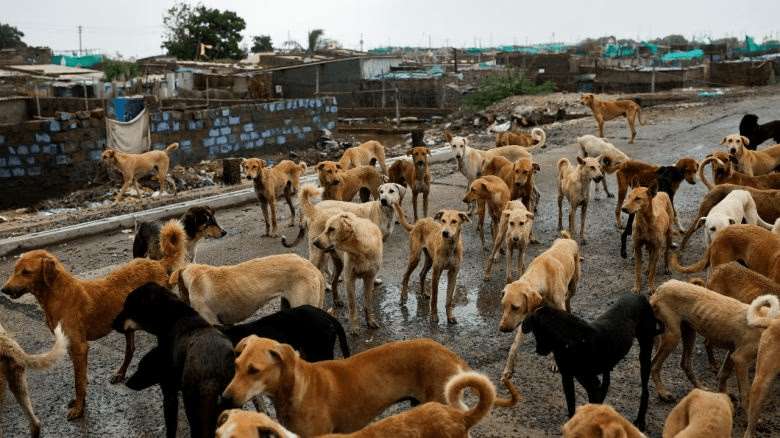
In case you are wondering if I woke up rather late and decided to pen my impressions on the late Frederick Forsyth’s 50-year-old novel The Dogs of War, his hugely successful effort after his blockbuster tome The Day of the Jackal, you would be gravely mistaken. Forsyth’s obsession with matters canine (a few years later, he wrote The Fox), even if only employed metaphorically as catchy book titles, put me in mind of the tremendous palaver that is currently ongoing in our own country about street dogs and what to do with them. I do not consider myself a fit candidate to add to the feast of reason and flow of soul we are presently inundated with, or how we should or should not be treating our dumb chums. Far weightier minds than mine are daily voicing their opinions and concerns, television news channels and social media have been cram-full with film clips of Jimmy and Rani and their doggie friends roaming the streets of Delhi unchecked, procreating without let or hindrance.
Not to be left out, even the Supreme Court, our ultimate arbiter of justice, has got into the act. Men and women have been running for cover while these hungry, half-starved creatures are, quite literally, demanding their pound of flesh. However, the fact that everybody who is anybody is holding forth (and fifth) on the subject is not about to deter me from shoving my oar in, even if many of the ‘shouters from the rooftops’ are barking up the wrong tree.
It may seem strange but the dog issue has overshadowed, at least in Bharat Mata, by some distance the shenanigans of all that is happening on the political front around the world. It’s a case of dog eat dog out there. ‘Cry havoc, and let slip the dogs of war.’ Putin to engage with Trump in Alaska* (or in Russia if Trump’s faux pas is to be taken seriously), Zelenskyy sulking in Ukraine, Xi Jinping smiling enigmatically like the cat that has had its cream and its rare earth minerals, the EU playing its cards close to its chest, Modi not quite certain which way he should be leaning while the Trump Tariff Sword of Damocles hangs precariously over our heads. Meanwhile the world holds its collective breath. It’s all happening, as the excitable Australian cricket legend Bill Lawry used to keep repeating in commentary. These are matters of state to be accorded the status of earth-shattering importance. Notwithstanding, the dog menace will not go away. Once it has got its bit between its teeth, it will gouge out whatever it can to keep body and soul together.
The body politic of India is versatile. We can engage with equal felicity on matters pertaining to tariffs and oil prices, alleged voter fraud with the Opposition and the Government throwing punches at each other, often below the belt while simultaneously addressing the vexed issue of dog bites and rabies if matters are left unchecked. In short, everybody is frothing at the mouth over dogs and ‘vote chori’ while diplomatic matters of state on the world stage are kept on the back burner, ready to bounce back at any time. Soon the Bihar state elections will be upon us and all the action will turn to pre-election mud-slinging, more voter fraud allegations and some strategic floor crossing to add fuel to the fire. When it comes to political argy-bargy, the bite is often worse than the bark.
To get back to the subject that is presently dogging our footsteps, let me state unequivocally that I am an inveterate dog lover and to watch the poor orphan pooches (pie dogs, as they are known) being hauled into vans with steel hooks as they squeal in pain, is nothing short of heart wrenching. This is not the first time we have witnessed such cruelty to animals, mainly dogs, and it won’t be the last either. Signature campaigns across social media eliciting support for a more humane solution to the canines’ plight appear to be falling on stony ground, as the Good Book says.
The other side of the debate, as voiced by many eminent personages including those from the judiciary, is that humans and children in particular, cannot be put in harm’s way simply because we are unable to find a solution to check the growth of the canine population. The Supreme Court reads the riot act, but who is listening? It’s a stalemate and a standoff. If I have heard passionate animal rights activist Maneka Gandhi on the subject once, articulating her position on behalf of Lassie and Fido, I must have heard her at least 100 times over the years. And we are nowhere near finding an answer. There are sterling folks around the country who have put all their resources to providing food, medical aid and shelter for stray dogs, but these are few and far between when viewed against the magnitude of the problem. A mere drop in the ocean. Not all the neutering and other methods of contraception and birth control appear to have made a blind bit of difference.
Which brings me to an interesting point. How is it that cats do not come into the picture at all? They are never a part of the conversation the way dogs are, in terms of creating a problem for the average human being on the street. Off and on, one does see the odd feline Jellicle cat lurking and moving stealthily looking for its daily rodent, or swiftly climbing up a tree if it senses danger in any shape or form. Rarely, if ever, does one come across ‘a pack of cats’ to coin a phrase, prowling around looking for victims on two-wheelers or pedestrians to pounce on. It is a mystery I cannot quite get my head around. If you ask me, I think cats have more brains than dogs and know how to look after themselves. Think about it. No one bathes their pet cats every week as they do with dogs. The kitties keep themselves spotlessly clean by the simple expedient of licking themselves all the livelong day. A saucer of milk at the window sill and a tummy rub is all they ever want.
To make confusion confounded, India’s Solicitor General Tushar Mehta, gave it as his considered opinion, and I am paraphrasing, that people who consume meat are hardly in a position to play bleeding heart when it comes to the subject of dealing with stray dogs. This was not the wisest path for Mr. Mehta to adopt as activists soon fell on him in a heap with those obvious old tropes like what are his shoes, belt, briefcase or watch strap made of, if not leather – ‘Look who’s talking?’ While the SG painted himself into an awkward corner there, his larger point was that we need to ensure adequate protection for the homo sapiens while attempting to find a sensible solution to the stray dog problem. Point taken but one needs to measure one’s words nowadays when the world, read Twitter (X) is watching, ready to parse every single word and sentence you utter.
All said and done, this appears to be an insoluble problem. We have not been able to solve it from time immemorial (at least here in India). After all, you can’t go around culling dogs en masse the way you do with birds during an Avian flu outbreak. You do not find stray dogs to be a frequent topic of conversation in most other nations. What is their secret? The Chinese have a way, but I dread to speculate on their methods. In order to plumb the depths and arrive at possible answers, I strongly suspect the Government will put together a bi-partisan parliamentary delegation of around 50 MPs who will fan out to different parts of the world to study how they manage to keep their streets free of dangerous stray animals. There will be fierce competition among the different political parties as to who should be nominated to this ‘K9 Dog Squad.’ The Congress will veto Shashi Tharoor which will promptly be met with a counter-veto by the BJP. In politics, as we all know, your enemy’s enemy is my friend. Amidst all the barking and yelping, Maneka Gandhi will probably win by a country mile. She is no longer an MP but an exception can be made.
That’s it. If you cannot solve a problem in India, get on a plane and spend some quality time in Switzerland or the Lake District. Stay away from Russia and Ukraine if you know what’s good for you. The same goes for the United States. There are some very nasty Rottweilers there snarling and baring their teeth this very minute. You can throw them a beef marrow bone but they will want the entire Holstein Friesian. You will be tariffed out of existence. You cannot teach an old dog new tricks.
*The Trump Putin Summit happened in Alaska, but nothing else happened. In the frosty conditions of Alaska, they warmly shook hands, bear-hugged and said nice things about each other. End of. No deal. Big deal! The foreplay did not yield a climax. Leaving Zelenskyy out in the cold. At least they could have taken a ride with the sleigh Huskies – lovely, furry creatures who never bark or bite. Then again, Trump is too busy taking the whole world for a ride!









 Suresh's Corner