Tell me about it

Sharing the same language but……

There might be some debate as to exactly what percentage of the world’s population speak the English language, but there can be little doubt that it covers a very large swathe of the globe. After all, not for nothing did the Brits sail around the world a couple of centuries ago, seeking whom they may devour. While their avarice to conquer and stay on as uninvited guests for long periods has been resented by the colonised, and rightly so, we need to graciously acknowledge their sagacious contribution in leaving behind a language that binds many nations and keeps the wheels of commerce well oiled. Else we might have been bumbling our way through with French, Dutch or perhaps, Portuguese. It is true that in each geographical region, the English language has been suitably adapted to cater to its own vernacular needs, resulting in uniquely different accents and emphases on words and phrases. Why, in India the way a typical Bengali speaks English is vastly different from how his compatriot in Chennai would hold forth in the same lingo. The native mother tongue influences the English pronunciation and phraseology. In that respect we Indians laugh at ourselves all the time, good-naturedly mocking our fellow countrymen and women.

The rapid spread of English has been, by and large, helpful though it has provided much comic relief when people attempt to mimic the way English is spoken in different tongues. All those years ago, British comic actors Peter Sellers and Spike Milligan, through their immensely popular Goon Show, attempted to create a ‘one-size-fits all’ Indian accent and had their admirers from all over the world helplessly rolling in the aisles. Listen to the song Goodness, Gracious Me! featuring Peter Sellers and Sophia Loren, recorded as a promo for the film The Millionairess (though excluded from the main film) and you will know what I mean. A more recent reprise of the same song, enacted by Rowan Atkinson (whom I otherwise admire) falls way short of the original.

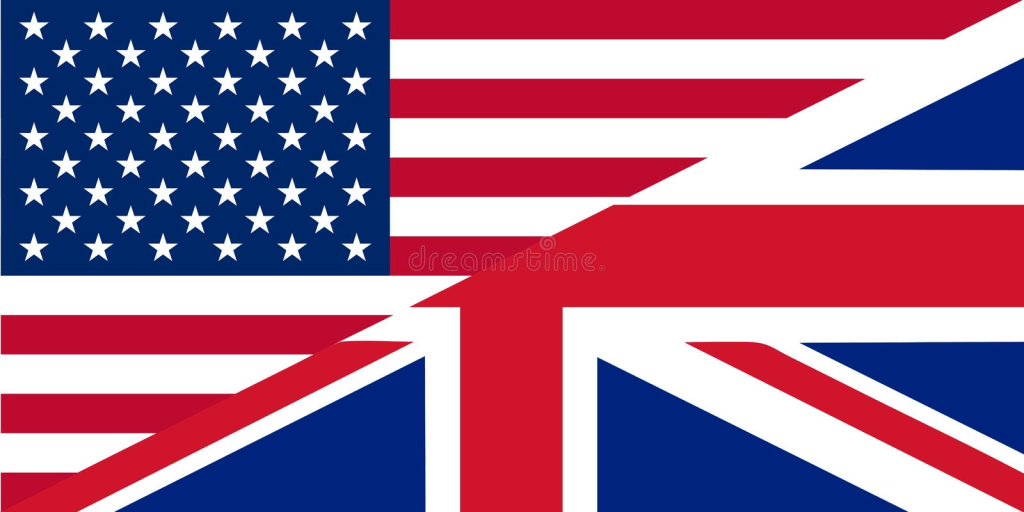
My own preoccupation for some years now, has had to do with the wonder that is the way English is spoken in the United States of America. Notwithstanding allowances made for marginal differences in the way a Texan would drawl as opposed to a New Yorker’s staccato, rapid-fire way of communicating, one can safely club American English into one unique slot. In India, for obvious reasons, most of us have been more used to the British way of speaking and writing English when it comes to spellings, idioms, phrases, aphorisms and so on. Bernard Shaw’s fictional Professor Henry Higgins (Pygmalion and My Fair Lady) famously complained that ‘in America, they haven’t used it (English) for years.’ The reason American English intrigues me is that, while they seem to be speaking English, there are many phrases and expressions they employ that continue to baffle me. The Australians too speak English in their own, unique way. Listen to former Australian cricket captain Ricky Ponting or eccentric tennis star Nick Kyrgios, speak. You will need an interpreter to translate what they are saying into decipherable English, but that is simply the accent. The Americans appear to have a vocabulary all their own. That said, now that we have cable television and any number of American TV serials and films readily available at our finger tips, English as she is spoke, particularly by the younger generation in India, is slowly but surely morphing from the Union Jack to the Stars and Stripes. And who are we fuddy-duddies to complain?

Several years ago, on my first visit to New York City, I called my hotel from the airport where I held a reservation. The conversation went something like this.

‘Good morning, my name is Subrahmanyan. Not Submarine. No, no, I am not from Suriname. My name is Subrahmanyan, and you are holding a single room for me. Could you kindly confirm the same? I should be arriving in about an hour.’

‘Can you spell that for me, please? I didn’t quite catch that. Just the first five letters should do it,’ replied the chap at the reception.

‘Right, here goes. S U B R A…’

‘Got it. Pretty long name, huh?’

‘Sub-rah-man-yan. Just four syllables. No longer or more unpronounceable than Zbigniew Brzezinski.’

‘How much?’

‘Never mind. The name, for the last time, is Subrahmanyan, Suresh.’ I was beginning to get just a little peeved.

‘Check. Copy that.’

‘How do you mean check, and copy what? Anyhow, you can copy it wherever you like. Just wanted to be sure of my booking. And by the way, Zbigniew Brzezinski was a former National Security Advisor of your great country. Just so you know.’

‘Whatever,’ he responded, laconically. I also suspect he was chewing gum.

I was to learn later that copy that means ‘noted and understood.’ We hear that often enough now in American movies. Back home in India, we were entertaining an NRI family from New Jersey. The husband and wife were to land up at our place for high tea along with their teenage son, who was finishing his schooling in the US. The couple arrived bang on time, the youngster was coming from elsewhere. While we were chit-chatting, the time flew by and their darling boy was yet to put in an appearance. The mother became quite agitated and called the tardy scion on the mobile and spoke in an exaggerated Yank accent. ‘Where are you, Raja? You were supposed to join us an hour ago, da. Will you drop whatever you are doing and come here already?’

Come here already? Never heard the word ‘already’ used that way before. Sounded like a contradiction in terms. In more recent times, particularly on streaming video, this phrase has become increasingly commonplace, and Indian kids, be they from the US or from India’s urban elite, are quick to latch on. To complete that high tea story, when the errant boy did arrive, he examined the generous fare on the dining table and exclaimed, ‘Goody, goody gumdrops! Am I going to pig out.’ Ah well, each to his own, I suppose. Speaking for myself, immense hunger would have driven me to venture, metaphorically, that ‘I could eat a horse.’ As for G.G. Gumdrops, the Americans and the British have been squabbling for long over who owns the copyright.  Let me quickly add here that phrases like I don’t care in place of ‘I don’t mind’ and my bad in place of ‘I am sorry’ have already become passé, a cringe-worthy part and parcel of our daily lexicon, such that I shan’t elaborate on them. Suffice it to say that, so far, so bad.

Let’s move along to behind the eight ball. The phrase, drawn from the game of billiards or pool, is meant to indicate that you are falling behind the competition in whichever subject is under discussion. ‘My friend, let me caution you that in the matter of winning the confidence of your boss, you are clearly behind the eight ball as compared to that greaseball, Jack. You had better buck up.’ I actually like this phrase, but if used indiscriminately, you will just come across as a boor and a show off.

I first came across the word period, when I joined school; 9 am to 10 am was Geography period, 10 am to 11 am was History period and so on. To say nothing of the British Period, the Mughal Period, the Chola Period, et al. We now know that this word has very many different meanings and shades, and I shan’t go through all of them here. (If she is having her period, show some understanding.) It is a common enough word. Period can also mean ‘full stop,’ and in the bygone days when we dictated letters, we would use the word frequently. ‘Dear Sir, Thank you for your kind enquiry about our tyres for animal-drawn vehicles period.’ Your smart secretary would automatically translate that to full stop. In the more trendy, conversational style of the present day, one is apt to say something like, ‘I do not wish to dwell on this subject anymore. Period.This, to indicate firmly, that the topic is irrevocably closed.

Here’s one that has not quite gained currency in India, but it will only be a matter of time. ‘Hey look, I have no time for late night parties. I am working the graveyard shift.’ Those swotting away in India’s IT and services sector speaking to clients all over the world, who start work at around 11pm and slog all night till the sun comes up, work the graveyard shift. It won’t be long before some of your friends start mouthing this phrase, if they aren’t already at it. I was also struck by yet another unheard-of beauty. ‘Wow! Where did you get your hair done? It’s absolutely on fleek!’ I have it on good authority that the expression denotes appreciation for a job perfectly done.

I end this far from comprehensive rumination on spoken or written expressions one comes across from ‘the land of the free and home of the brave,’ spreading like a rash to other parts of the world. If you have come this far with this piece, lolling back and going out of your way to find nasty things to say about it, you are nothing more than a mean, old Monday morning quarter-back. The phrase is obviously derived from American football, which is not football at all. At least, not as we know it. Why this hyper-critical quarter-back chooses Monday mornings to vent his spleen on his colleagues is an even greater mystery. I will now need to scour Wisden’s cricket almanac to find a suitable local riposte. At that I may not even get to first base. I think I’ll just take a raincheck, ride shotgun with my friend in his Audi and shoot the breeze.

American English. Some may say it sucks. Will my English masters in school have approved? Not on your nelly (that’s British), and they are unlikely to have said, no can do. My 21-year-old grand nephew just called me from Chennai. As we were ending our brief chat, he said, ‘I’ll ring off now. Peaceful.’ This, for a change, may be a recent Indian coinage but puzzling, all the same.

Tell me about it.

Are we ‘Ready for Rishi?’

When Joe Biden assumed office as President of the United States on January 20, 2021, here in India there was much excitement. Not because anyone in India gave a toss about Joe Biden. The appeal of American Presidents to the Indian public, both domestic as well as the diaspora, depends largely on whether they are good looking or so ridiculous that you have to pay close attention. On that score both John Kennedy and Donald Trump, for those very reasons (you can work out which applied to whom), merited our keen interest. In the case of Biden, our curiosity in India had much more to do with his vice-presidential candidate, Kamala Harris because of her Indian antecedents. That she was also part West Indian on her father’s side did not seem to matter. Perhaps some sections of the Indian public interpreted West Indian to mean Mumbai and not Jamaica. However, for a few, brief shining moments, those of us from south India, particularly Chennai and its environs, went ballistic with joy. Reams were written in Indian newspapers about Kamala’s maternal family background from a conservative Tamil Brahmin household. Unknown relatives crawled out of the woodwork. Which also meant that her love of the cuisine from that part of India, including idli, vada, dosa and curd rice received as much billing as her untested political nous. If she also enjoyed spare ribs and beef steak, we did not mention it.

All very droll. That was over a year ago, when Kamala Harris was sworn in. In that period, even if she was not being publicly sworn at, it was a near thing. At any rate, she appears to have gone clean off the radar. Not even a blip. No one talks about ‘our Kamala’ any more. Not even in suburban Chennai. Lotus (Kamala in Sanskrit) is unlikely to become POTUS, unless Biden decides to throw in the towel before his term ends. I have heard tell that a soothsayer has predicted the lady could get the top job before Biden’s term ends!  Such is the fickle, ephemeral nature of fame.

That preliminary introduction about Kamala was prompted by the current hullabaloo we are witnessing over the possible ascension of an Indian-origin candidate, Rishi Sunak, as a potential successor to the ousted Prime Minister of the United Kingdom, Boris Johnson. The Indian media, social circles, our neighbours, friends, relatives and possibly their pet dogs, are all waiting with bated breath to see if young Rishi (he is only 42) can become the first non-white Prime Minister of Great Britain, albeit a tad wet behind the ears. Incidentally, my friends who are clued up on these things, assure me that the terms United Kingdom and Great Britain (and by inference, even England) are freely interchangeable. The golden rule appears to be that if they win the football World Cup, which they did against West Germany 4 – 2, in 1966 at Wembley (aided by a controversial third goal), or an Olympic gold, the cry will ring out, ‘another triumph for Great Britain.’ Whereas if they lose, it will change to ‘England loses again.’ It’s complicated but it is what it is. Scotland, Wales and Northern Ireland don’t count.

Let’s get back to the bright-eyed and bushy-tailed Rishi Sunak. Straight off the bat, let us recognize that the aspiring PM is no more Indian than Boris Johnson is Punjabi. Sunak’s parents came over to the UK from East Africa in the 1960s, as did thousands of others of their ilk, thanks to the tender ministrations of Idi Amin, and ran a successful if modest pharmacy, which may or may not have been a traditional corner shop. Sunak was born in Southampton and the rest of his meteoric academic and political career has been well documented. I shan’t go over them again. My preoccupation is more to do with why we in India are going all gaga over someone who is attempting to become the Prime Minister of a nation that ruled India for close to 200 years. Is it the Indian origin thing? I haven’t even heard of a family in India called Sunak! Nasser Hussain captained England’s cricket team and worked overtime to convince his countrymen that he was English, and not just a fair-complexioned lad from Madras with a posh public-school accent. Is it the pigmentation? Could be, but if you walk around Central London and hurl a brick randomly into the middle distance, you are more likely to bean someone of an Asian, African or Middle Eastern descent. Let’s cut to the chase. I’ll tell you why we in India are getting super excited about Rishi. He is married to a true-blue Indian girl. That’s why! He is our son-in-law; Daamaad, Jamai babu or Maapillai, depending on which part of India you hail from.

There’s more. Rishi’s father-in-law, N.R. Narayana Murthy can safely be described as one of the fathers of India’s IT revolution. A highly principled, self-made man, he is one of the many poster boys in India’s rise as an economic power house, thanks to the company he founded, Infosys. Not that Mr. Murthy would himself care to be described as a poster boy, he being of a somewhat modest and self-effacing disposition. His educationist and philanthropist wife Sudha Murty (she drops the ‘h’ in her surname, insists her husband’s name is spelt incorrectly!), is a woman of substance in her own right, seen as a role model for the betterment and upliftment of women, children and the downtrodden. She is a prolific writer having authored many books, in particular for children, and is ever ready to reach out to the needy with a helping hand. And their daughter Akshata it was who said ‘Yes’ to Rishi Sunak when he popped the question to her on bended knee in the sylvan surrounds of Stanford. And now, dear reader, can you at all be surprised that in India, it is a completely different kind of rishi all the way from the UK who is hogging the headlines as opposed to the ones we are so accustomed to seeing? This one is suited, booted and clean-shaven, and speaks with an Oxbridge accent. Not a tinge of saffron anywhere.

The rishi double entendre is even more apt when you consider the fact that Rishi Sunak is reportedly a practicing Hindu, and that he took his oath as Chancellor of the Exchequer with his hand placed firmly on the Bhagavad Gita. Should he ascend to the exalted office of Prime Minister and take that short hop from No.11 to No.10 Downing Street, Britons will be counting many ‘firsts’ in their rich political history. This also raises a pertinent question. When push comes to shove, is a predominantly Christian nation such as the United Kingdom ready to entertain a devout Hindu (one assumes he is devout) as their chief executive? In order for that to happen, Sunak has to take on some stiff headwinds from his shortlisted colleague, Liz Truss, who is fond of saying, ‘we’ll hit the ground running.’ While the lawmakers from Britain’s Conservative party have selected these two worthies, the complex voting process will take place through a balloting system involving some 200,000 party members in early September. Notwithstanding Sunak receiving more votes than his rivals in the initial phase, Liz Truss could well be holding all the aces. She could be following in the footsteps of Margaret Thatcher and Theresa May as the third woman Prime Minister of ‘this sceptered isle.’ There’s everything to play for. At some point during these proceedings, erstwhile Prime Minister Boris Johnson will quietly make his way out of what can surely be described, in his case, as ‘10 Drowning Street.’ If you read that gag in one of the British tabloids, remember you saw it here first!

Meanwhile, not to be outdone, we in India are witnessing our own history in the making. The ruling dispensation’s candidate, Droupadi Murmu, is all set to take the oath as India’s 15th President, and the second woman to do so. The uniqueness is derived from the fact that President Murmu (get used to that name) hails from a tribal community in the state of Orissa. The BJP has once again caught everyone, particularly the opposition parties, completely off guard. The move is seen as being far-reaching, statesmanlike and above all, a sure-fire vote catcher – depending on whether one is a supporter or a cynic of the government in power. India’s Prime Minister, meanwhile, sits back comfortably and smiles beatifically. Like the cat that’s had its cream.

A final thought on what it could mean for India if Rishi Sunak does, indeed, make it to 10 Downing Street, provided he can get past Liz Truss. Not very much, I don’t think. Rather like Kamala Harris, Rishi will need to keep an arm’s length distance from his ancestral nation, lest his countrymen come down on him like a ton of bricks. The British press are already pooh-poohing his ‘humble-humble’ background claims. His wealth and their sources are being closely examined with a fine toothcomb. In other words, he will have enough problems running the country without pointedly cosying up to India. This may create some domestic unrest at the Sunak household at No.10, but that’s the way the cookie crumbles when you sit on the hot seat. However, let us not get ahead of ourselves. As I put this piece to bed, the smart money has Liz Truss with her nose in front as the odds-on bookies’ favourite. She may well pip Sunak to the post in this two-horse race, in what could be a photo finish. Sunak’s nick name to some of his close friends is ‘Hedgie,’ derived from the fact that he had earlier worked in the hedge fund business. He will certainly be hedging his bets now. But just in case Sunak defies the odds and pulls through, is India, in the words of his campaign plank, ‘Ready for Rishi?’ Maybe, maybe not. Either way, I shan’t be holding my breath.

Postscript: This could be apocryphal, but a group of Indian tourists to the UK, visiting Winston Churchill’s burial site at St. Martin’s Church, just outside Blenheim Palace grounds, swore they felt something turning in his grave!

Music that shakes and stirs

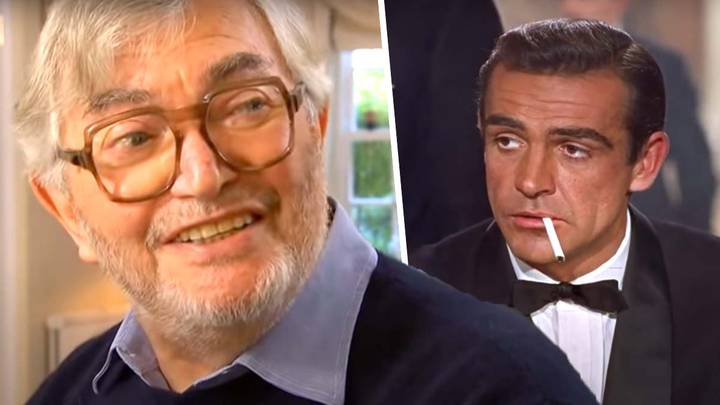
Monty Norman and Sean ‘Bond’ Connery

I haven’t understood a bar of music in my life, but I have felt it. Igor Stravinsky.

Monty Norman died earlier this week at the age of 94. I am sure most of you are going, ‘Monty who?’ Which is hardly surprising. My reaction was no different. Then again, on reading his obituary and discovering that this was the man who composed the unforgettable signature theme music for the James Bond films, I sat up and took notice. The music was indelibly imprinted on my mind, but the composer was an unknown quantity. Which is often the way. People of my generation have lived with the James Bond theme since we were barely into our teens. Never mind if the screen Bond switched from Sean Connery to Roger Moore to Daniel Craig and a few other lesser mortals in between, Monty’s theme tune remained constant. There were a few songs as well, thrown into the mix of this famous franchise by the likes of Matt Monro (From Russia with Love), Shirley Bassey (Goldfinger, Diamonds Are Forever, Moonraker), Paul McCartney (Live And Let Die) and more recently, Madonna (Die Another Day), Adele (Skyfall), Billie Eilish (No Time To Die) and several others too numerous to mention. Those of you who remember the very first James Bond film Dr. No (I watched it again recently on cable), will recall a popular calypso/reggae-inflected number, Underneath the Mango Tree, set in the sunny beaches of Jamaica. The credit for that composition also goes to the self-effacing Monty Norman. Lest we forget, many of us also devoured Ian Fleming’s Bond books, which attained glamour and an iconic status on the silver screen.

To get back to the main, unforgettable James Bond theme music, I was fascinated to learn that the composer, Monty Norman, while struggling to hit upon the idea for a tune, arrived at his jackpot theme from something he had composed much earlier but was put away in cold storage. At the time, he was invited to compose the music for a stage play based on V.S. Naipaul’s acclaimed novel, A House for Mr. Biswas, and he came up with this very Indian type of raga-based, bouncy melody – tabla and sitar thrown in for good measure. As it happens, for reasons unknown, the play never saw the light of day and the tune remained hidden; ‘born to blush unseen and waste its sweetness on the desert air,’ as the poet Thomas Gray might have put it. The composer, our Monty, decided it was high time the tune received its due recognition. He unearthed the song from obscurity, reworked it completely and voila! History was made. Ironically, the Bond franchise, over the decades has been celebrated for a variety of different reasons but Monty Norman was never one of them – at least not in the glare of public limelight and it was only in his passing that his name has received its overdue accolades. The Monty(s) most people I checked with in India were aware of included the zany sitcom Monty Python, General ‘Monty’ Montgomery and even lesser-known English cricketer, the Sikh Monty Panesar. This despite the fact that the Monty under discussion was honoured with the Ivor Novello Award for the ‘James Bond Theme,’ used in the films’ opening sequences or most intense action scenes.

There is a spicy twist to this Monty tale. In London, the producers of the James Bond films decided to hire composer John Barry to rearrange Monty Norman’s original track. He tweaked it around a bit and over time Barry’s name became inextricably linked with the Bond sound and he was credited as its creator. Naturally, this did not sit well with Monty. Hackles raised, he approached the courts in 1997 to claim authorship of the work. In 2001, a jury returned a unanimous and popular verdict in his favour. Bully for him, say I. Credit where credit is due. I can express it no better than The Wall Street Journal’s correspondent, Marc Myers. ‘For millions of baby-boomer males who saw their first car chase and sex scene in a Bond film in the ’60s, the theme song stirs powerful psychological coals, flipping a primal switch as images of silencers, casinos, bikinis, gin and gadgets flood the male brain.’ Not forgetting the ‘medium dry vodka martini, lemon peel. Shaken, not stirred.’

While we remember the signal contribution of Monty Norman’s music to the James Bond franchise, I would like to take this opportunity to put together a brief and highly subjective selection of other movies where the theme music has, in my personal opinion, been truly stirring. I hasten to add that I am not talking songs here, just the music that the film has come to be inextricably associated with. These are not in chronological order. I am merely putting them down as it occurs to me. A kind of top-of-mind exercise, if you like. In keeping with my observations on Monty Norman and the Bond films, the composers of the music for these films were not known to me. I had to look them up, which only underscores the whole point of this piece. I am not here referring to musicals like The Sound of Music, My Fair Lady, West Side Story, South Pacific, The King and I, Hair, The Phantom of the Opera, Cats and so on, which were peppered with songs every few minutes. My preoccupation is with dramatic films enhanced by a powerful and emotive musical score.

Let’s start with Lawrence of Arabia (1962). This David Lean spectacular with a multi-star cast swept us off our feet in 70 mm splendour and magnificence. When the theme music broke some time well after the opening sequence (flashback to Lawrence’s fatal motorcycle accident) and kept being repeated time and again, rising to a crescendo, the experience was truly elevating. Many of us went to the theatres to see Lawrence multiple times as much to enjoy the music as to wallow in the histrionic brilliance of Peter OToole, Alec Guiness, Anthony Quinn, Omar Sharif and the rest of the glittering cast.

We again turn to a David Lean magnum opus, Dr.Zhivago (1965), starring Omar Sharif (he was everywhere) and Julie Christie and ‘a cast of thousands.’ The theme music, composed by Maurice Jarre (I looked it up) became a musical leitmotif to remember for all time to come. The tune was so hummable that popular singers fell over each other, with lyrics added, to record a memorable hit song, Somewhere my love. Connie Francis and Paul Webster were among the earliest to clamber on to the hit parade bandwagon as Lara’s Theme was on everyone’s lips.

Speaking of Lara’s Theme, I will now expend a few lines on, believe it or not, Tara’s Theme. The close similarity of the two names is entirely coincidental. We are now turning the clock back a few decades to that other all-time classic, Gone with the Wind (1939). With Clark Gable and Vivien Leigh heading up a strong cast, the film as well as Margaret Mitchell’s book on which it was based, is indelibly stored in our collective memory banks. Contrary to what I might have imagined, Tara is not the name of a character in the film but that of a fictional plantation in the state of Georgia where much of the action takes place. The theme music again, is one for the ages. Over the years, including quite recently, there has been some controversial static over the film (and the story) being ‘racially insensitive’ and some theatres even pulled the movie under public pressure. That has never come in the way of the film retaining its iconic status. As the hero Clark Gable’s character, Rhett Butler’s throwaway line at the end of the film says in a different context, ‘Frankly my dear, I don’t give a damn.’

The list of Hollywood movies with a memorable theme music soundtrack is long and many of you reading this can add sumptuously to the list. This is to prevent people writing in with ‘What about Casablanca?’ or ‘You forgot to mention Bridge on the River Kwai.’ And so on. However, I shall end this nostalgic contemplation of great film musical themes with The Godfather trilogy. Nina Rota, remember the name, will forever be celebrated and lionised for the music soundtrack of the entire Godfather franchise. As I had suggested at the top of this piece, the name does not roll off the tongue easily, but that does not detract from his monumental contribution to the success of The Godfather I, II and III (1972, ‘74’, ’92). As much as we loved Brando, Pacino and DeNiro as well as those unforgettable sequences that all but idolised the Mafiosi’s way of life, the haunting musical theme and its umpteen variants in the trilogy quietly sank into our subconscious and has remained there, never to be forgotten.

Theme music in films. It is a vast subject worthy of a doctorate dissertation paper. I should be surprised if somebody has not already done it. I have merely attempted to share a soupçon from my own experience. While songs are great and we all love to sing them, pure, wordless music can at times ineffably express the inexpressible. We have much to thank Monty Norman and the movie industry for.

Dear diary

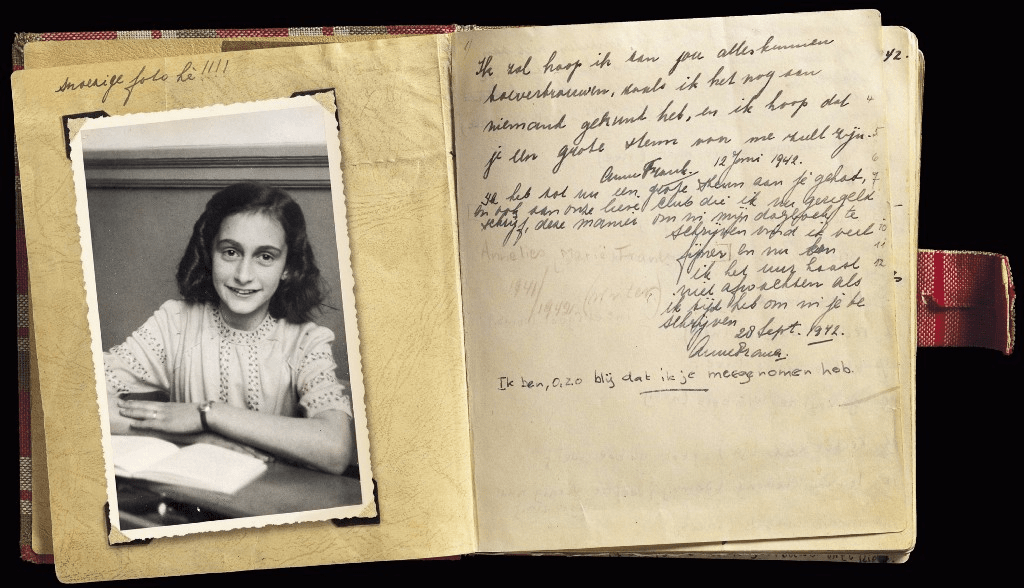
A faded page from Anne Frank’s diary

The nicest part is being able to write down all my thoughts and feelings; otherwise, I’d absolutely suffocate. Anne Frank, 16 March 1944.

Anne Frank’s diaries are now part of literature’s legend and song. The young Jewish Dutch girl, who was gifted a diary in 1942 when she was barely 13 years old, poured her heart out in those invitingly blank pages. Over the next couple of years, hiding in a secret attic in Amsterdam to keep away from the depredations of Nazi occupation, she wrote prodigiously; about her growing up in such forbidding conditions, about her sense of self and above all, about the ever-present danger of capture and the dreaded concentration camps. In spite of all that, she constantly exuded positivity in her pages and thought nothing but good in the human soul and spirit. The best-selling book, The diary of Anne Frank ends on a high note of optimism. Describing herself as a ‘bundle of contradictions,’ Anne Frank had this to say about her general outlook on life. ‘As I’ve told you many times, I’m split in two. One side contains my exuberant cheerfulness, my flippancy, my joy in life and, above all, my ability to appreciate the lighter side of things.’ She could have been speaking for me as far as ‘appreciating the lighter side of things’ is concerned. I can barely bring myself to imagine what the darker side of things must have been for Anne.

My thoughts, however, are concerned more with the humdrum aspects of life that we used to post in our own diaries many moons ago. If that suggests going from the sublime to the ridiculous, so be it. Question: do people maintain personal diaries nowadays? I have met the odd person who does, odd being the operative word, and chances are that these oddities were born during the forties and fifties or perhaps even earlier. This is not to say that stationers, book sellers and some organizations do not print diaries (and calendars) which are avidly sought after, particularly during the dawn of a new calendar year. These specimens are essentially meant for those who are not quite au fait with the digital versions on their mobile phones or personal computers. I have also been amazed at how, when November and December came around, so many people would be seen running helter-skelter looking for diaries or calendars to cadge from wherever they could lay their hands on. It was almost as if diaries were about to become extinct. And that is almost true.

 For the most part these diaries are the exhaustive repositories of laundry lists, provisions purchased, sundry expenses, not to mention birthdays and other milestones that one needs to be reminded of in order to send flowers or make that courtesy phone call. It carries infinitely more weight than being reminded by Facebook. My father, who passed on in his late eighties about twenty years ago, was a stellar example of a man who jotted down all manner of details about his family and close friends in a tattered and torn diary that was well past its sell- by-date. His diary would also contain faded newspaper clippings of anything that he thought might be of interest for future reference. If I was lost in trying to hunt down some old news item about somebody in the family, all I needed to do was ask him. Why his personal diary was considered a safe haven for these snippets, which also worked as bookmarks, was a closed book to me. That said, I know many people who acquired several diaries and simply stowed them away in a safe place, never having even opened them! However, try prising one of these moth-eaten items out of them and they will get all cagey and evasive.

During our boarding school days, and here I am harking back to the swinging 60s, some of us boys maintained little pocket diaries, or just a plain exercise book which worked just as well. Only we had to write in the date on which we were entering our profound thoughts. The school administration encouraged this activity during our spare time and holidays, as they felt it would improve our writing skills. That was a laugh. Most of the boys would vent their spleen on other boys, or even on the masters, in ways hardly calculated to improve their knowledge of the language. If the school honchos got their grubby hands on these incriminating tomes, there was hell to pay but that was a risk the boys were willing to take. Here are some samplers, drawn from varying imaginary dates. I have randomly chosen the year 1963 for no reason other than the fact that President John Kennedy was assassinated that year, Martin Luther King made his famous ‘I have a dream’ speech and not to put too fine a point on it, I discovered The Beatles. These milestones leave a lasting impact.

25th July, 1963 – Acted in our school play, ‘The Language Shop.’ Was cast as the Weak Verb. Hell’s bells! Why couldn’t the director give me the role of the Proper Noun or something. I got awful stick from the Transferred Epithet and the Definite Article. The Indefinite Article, like the Weak Verb, was considered a pariah. Enough to drive anyone up the wall. I was the laughing stock of the school.

Actually, the play was pretty smart. Plenty of puns and humour calculated to enable us boys to appreciate the language better. But Weak Verb? I deserved better. I could have been the Strong Verb, if there is such a one. Wren & Martin, what say you?

17th August 1963 – Somebody has torn a huge hole in my mosquito net. I think I know who it is. It has to be that cowardly cur, Charlie the Chump. You’ve got it coming Charlie boy. Where is that old bottle of ink?

Not the finest example of the language of Shakespeare, but more on the lines of Enid Blyton’s Famous Five. Always remembering that we were in our early teens. As to what the chronicler proposed doing with ‘that old bottle of ink’ is anybody’s guess.

21st August 1963 – I got just 27 marks for my geometry paper. I first thought it was out of 50, until I was told by our maths teacher Mr. Caleb, that it was out of 100! Meaning I plugged! Shit -o! What am I going to tell my pop when I write to him this weekend? Bloody Pythagoras!*

That was a typical entry. ‘Plugged’ by the way, was schoolboy slang for failed. I don’t know what it is, but we always came out of our exam halls exuding disproportionate confidence. ‘I think I maxed it,’ was the standard, hubristic response to being asked how we fared. We might have cried into our pillows after lights out at night, but no one noticed. Matron had to deal with plenty of moist pillows in the dormitory next morning.

*As this blog is being put to bed, news has just filtered through, that educationists in India have questioned Pythagoras’ theorem and Newton’s apple gravity claim as being possibly fake and that they have most likely taken their posits from ancient Indian texts. Mera Bharat Mahaan!

29th August 1963 – I told the skip not to place that fat slob Ganga at first slip, but does he listen? He goes and does just that, and a dolly catch spilled off my bowling. Butter fingers! Screwed up my bowling analysis. I shall make sure to grass the next catch that comes my way. You wait and watch.

Ah, school cricket politics. It was worse than what we witness now at the BCCI. The fight for a place in the school eleven for any representative game was fiercely intense. Those who missed out made no bones about what they thought of the selector, namely, the poor games master. Invective was hurled, behind closed doors; or closed pages, naturally.

2nd September 1963 – How the hell did he pick Yousuf ahead of me? And why Ranjit, for God’s sake? Neither of them can hold a bat straight and they are the biggest, what’s the word, ah yes, liabilities on the field. Something very fishy going on here. I shall send an anonymous letter to the Warden.

22nd November 1963 – One of the house prefects comes barging into our dormitory early in the morning shouting, ‘John Kennedy is dead. Shot by some crazy lunatic.’ Big deal. What was John Kennedy to me? I was much more interested and excited by the news that The Beatles have released their second album ‘With The Beatles’ on that very day. Their debut album, ‘Please, Please Me’ was also released earlier in 1963. I mean, for a 14-year-old in the early 60s, given John Kennedy vs The Beatles, who will win? Go figure.

There you go. Most of us boys were not precocious beyond our years to grapple with deep, contemplative thoughts about the world, the theory of evolution or delve into theocratic or philosophical thoughts. Cricket, comics, classroom capers and pop music tended to fill our waking moments. Oh yes, girls did occupy our thoughts now and then and a typical diary entry would go something like this:

November 26th – Four of the boys went to visit their sasses today. They came back with autograph books for some of us boys to sign on the ‘Wall of Friendship.’ Guess what, I am on the list of three of them. What do I write on them other than signing the damn things? And why was I not on the fourth list? Woe is me! I shan’t sleep tonight.

In case you were wondering, ‘sasses’ was school shorthand for sisters. Anyhow, such was the childish silliness that our diaries were filled with. If you ask me why we were not inspired by the likes of Anne Frank, the answer is simple. We were not even aware of her till many decades later, and then too only because of her diaries. If there are those in 2022 who maintain diaries and jot down their thoughts and activities, I doff my metaphorical hat to them. I would like to maintain a diary again but the moment has long since passed. I write blogs instead. Oscar Wilde, who always had something memorable to say about anything at all said, ‘I never travel without my diary. One should always have something sensational to read in the train.’ Most of us don’t lead the kind of sensational life Mr. Wilde did. Which is just as well.

The law is not an ass

The sitting judge at the Delhi High Court (take a bow, you wigged worthy) has just ruled that a woman is perfectly within her rights to donate any organ from her body to a cause she deems fit without seeking prior permission from her husband. In the legal argot so favoured by judges, it was noted that applicable rules did not mandate any ‘spousal consent’ in case of organ donation to a close relative. Adding, quite tersely, that ‘she is not a chattel, it is her body.’ Hear, hear. All you husbands out there contemplating sympathy from our justice system, you are duly warned. If your wife comes home one of these evenings and announces that she has just divested herself of one of her body parts in a good and noble cause, you cannot fly into a mad rage and start flinging the crockery around and haring off to courts. In this particular case, the body part concerned was one of the woman’s kidneys which she decided to donate to her father. Her kidney, her father, she may do as she pleases. No prior consent from her hubby required. As any student of medicine will tell you, a human being can lead a perfectly normal life with just one kidney, so what is all the fuss about? Two kidneys are not entirely surplus to requirements (they were placed there for a purpose) but push comes to shove, one is enough, ‘twill serve.

That appeared to be the broad view of the honourable judge of the Delhi High Court. Not sure if the estimable purveyor of justice, while pronouncing the verdict recalled Hamlet’s memorable line, ‘There are more things in heaven and earth, Horatio, than are dreamt of in your philosophy.’ Had he done so, he would have been moved to paraphrase Shakespeare while admonishing the husband, ‘there are more things to worry about than your ego. Your wife donated her kidney to her dad. The matter ends there, the law does not require her to obtain an NOC from you, so let’s have less of your chauvinistic protests. Mr. Bumble from Oliver Twist might think “the law is an ass,” but we beg to differ. Take her to a nice movie, and dine out afterwards. That’s the least you can do to show your appreciation to a noble gesture.’ Well said, m’lud. A judge after my own heart. Knows his Dickens as well.

This unambiguous ruling clearly puts the husband in a bit of a quandary. Taken as a precedent, as all judicial rulings generally are, husbands across the land will be fretting every time their wives come home late in the evening, wondering if they are in possession of all their anatomical parts with which they were born, or have they been scattering parts of their body to the winds, unmindful of domestic consequences? Enough to put any husband off his dinner. The following exchange could be a typical conversation at a couple’s home, after the husband returns late from work to an empty home, his wife yet to return from work. She is normally back earlier than her beau. He has just helped himself to a drink when their merry cocker spaniel lets out a piercing, happy yelp indicating that the good wife has just driven in. Dogs know these things. She lets herself in quietly.

The husband opens the proceedings. ‘Hullo darling, long day? You are never this late. You look a bit bushed. Everything all right?’

The wife, after dealing with the customary passionate greeting from the spaniel, responds. ‘Why do you ask? Why should everything not be all right?’

‘No, no, simply asking. Another tiring day at the office, eh? You normally get home by six, it’s half past eight now. Just wondered, that’s all. Are you sure you are feeling fine?’ The husband was obviously fishing and his better half could sense that.

‘You seem to be wondering about things a great deal. I come late one evening and you seem to be imagining all kinds of things. Precisely what is it that you are concerned about? I am not having an affair, if that’s what is bothering you.’ She was clearly a bit tetchy, and it showed.

‘That is uncalled for and beneath you. Look, any responsible husband would be concerned if his wife comes home unexpectedly late. You should be happy, not become irritable simply because I asked after your welfare. But since your brought it up, why have you covered your left ear with the end of your sari?’

‘What?’ The lady of the house was beginning to lose it.

‘Just curious, that’s all,’ replied the hubby trying to sound calm. ‘I mean, you normally never cover your head with the pallu, and yet here you are, only your left ear covered whereas the right ear is fully exposed and looks as normal as any right ear should. What gives?’

‘My dear husband of fifteen years, can you please explain what is behind this incoherent jabbering. Is that your first, or seventh large peg? You are not making any sense. Are your sodium levels dropping again? Should I call the GP?’

As she was making these inquiries after her husband’s health, the offending sari end dropped to her shoulder and it was plain that her left ear was fully in place.  No bandage, no Van Gogh syndrome visible. While that brought him some relief, he now started worrying about other parts of her body. He muttered to himself, ‘thank heavens for that.’

She was beside herself. ‘Thank heavens for what? Look, I am going batty here. What is your problem, exactly? I’ve had a difficult day at the office, and I come home to this. Will you kindly explain what’s biting you? Perhaps we should drive you to the hospital and get a quick check up done.’

He calmed down. ‘Look my dear, let me come clean. I have been reading about how a judge in Delhi ruled that a wife need not seek her husband’s clearance to donate any part of her body to someone, especially her close relative, if she so desires. If you have any such intention, you will talk to me first, won’t you? Don’t think of it as seeking permission or anything like that, but just to let me know. A second opinion is always useful, if you wish to go through life without one of your big toes. Albeit in a good cause, of course.’

‘You really have gone bonkers. And you thought I might have donated my left ear to someone? I know where you are getting all this from. I too read the papers. That was a case of a woman who donated her kidney to help her father’s critical medical condition. The judge was merely emphasising that her husband’s permission was not mandated by law. End of. Tomorrow, God forbid, if you needed a kidney, would I not come forward, even without your permission?’

‘Thank you, light of my life. That is most comforting. I simply wanted to make sure you don’t suddenly turn up and go, “ta da, look ma, no hands.”’

‘I honestly think you are suffering from an acute case of paranoia. Every time I return late from work, you will start imagining me with something missing from my body. Lung perhaps? Eye, people do donate eyes, don’t they? You’ve already lopped off my left ear. Dread to think what else you’ve been chopping off. I would suggest you stop reading the papers. TV news is much better. You won’t follow anything for all the cacophony and you might even go to sleep.’

And so, in hundreds of thousands of households in India, similar heated exchanges are taking place even as this piece is being put to bed. The Delhi High Court ruling has set the cat among the pigeons and husbands are lying awake in their beds, tossing and turning restlessly, unable to sleep and wondering if their wives are levelling with them or is there something missing and they are in the dark? Last we heard on the subject many males of the species were examining their bodies closely to see if they can get rid of some unwanted parts without their wives knowing. After all, they now have a precedent. And judges love precedents.

The Office Secretary – a vanishing breed

No one needs a word processor if he has an efficient secretary. Robertson Davies.

Let me declare at the very outset I had no idea who Robertson Davies (1913-95) was, when I came across that quote, and like any diligent writer I looked him up. Evidently one of the foremost novelists, playwrights, journalists and poets to come out of Canada; if I had not heard of him, that is down to my ignorance and no reflection on the man’s reputation. His relevance to this piece is his quote on the office secretary which I came across quite by accident, and the subject on which I was spurred to expound. Now the curious thing about that particular pearl of wisdom by Mr. Davies is that in the context of the present day automated, mechanized world in which we live, it could so easily be flipped, with much relevance, the other way round, viz., ‘no one needs an efficient secretary if he has a word processor.’

I have no wish here to wander aimlessly into a meaningless debate on the numerous advantages in terms of overall efficiency the word processor and the computerized age, with its improvements by the nanosecond, have brought to our lives. Ipso facto, nor will I get into the relevance or otherwise, in this day and age, of a human secretary, expert on Pitman’s shorthand, typing and making a nice cup of tea, adding to our overheads as conventional present-day wisdom appears to suggest. That is old hat, and not germane to this piece. Au contraire, I am about to get misty-eyed about an age when our work places (I abhor the term work stations), were full of bright-eyed and bushy tailed lady secretaries, smart as a whip, sashaying through office corridors with a welcoming smile first thing in the morning, ready to face anything you had to throw at them, barring the glass paperweight.

During my early working days in Calcutta, from the early 70s till the end of the 90s, I had the good fortune to put in a long stint in one of India’s best known multinational tyre companies. In keeping with the practice of nearly all such establishments in the city, and indeed the country, the company I served had an impressive retinue of lady secretaries working exclusively for officers of a certain grade and above. On the very first day that I joined the company, I was guided to my ‘chamber’ and introduced to my secretary. Never having worked with one before, I was a bit lost. My own personal secretary? Crikey! My earlier jobs in a couple of advertising agencies, in a far more junior capacity, involved using pool (or shared) typists to whom we would hand over handwritten notes to be typed up as drafts, followed by the final version. Suddenly confronted with a bright secretary, armed with notepad and pencil and a sheaf of correspondence to be attended to, it dawned on me that I had to dictate my letters. A new experience. After a few days of stuttering and stammering, I got into the groove of things, and became more comfortable with this business of dictating letters and notes. ‘Dear Sir/Madam, with reference to yours of blah, blah, blah, I find your quotation for printing 5000 radial tyre posters in 4-colour offset unreasonable and extortionate. Kindly revise your estimate drastically downwards else I will have to look at other options. Yours blah, blah, blah.’ I was beginning to get the hang of it, and my secretary was full of words of encouragement. ‘You seem to be a natural. Nice word, extortionate. Your predecessor was a nightmare.’ Well, I mean to say! I was chuffed.

There was a clear pecking order in the way in which corporates of those days arranged the boss-secretary set up. In ascending fashion, at the junior level, once you were entitled to your own secretary, she sat in the same room as yourself. If you wanted to have a confidential chinwag with someone, you had to politely ask her to leave the room. Also, slyly picking your nose was out of the question. One level up and there was a partition between the two of you, allowing a certain amount of privacy. At the very top of the tree, general managers, vice-presidents, directors and the like worked out of what seemed like plush 5-star suites. The boss himself had a large room, with wall-to-wall carpeting and at least one window overlooking the street, a corner office would fetch you two windows; their secretaries wallowed in their own luxurious ante-chamber, with a sofa thrown in for those who had to wait anxiously in the queue to see the big chief.

That was the broad geographical set up. The secretaries themselves were an integral part of the company’s working. Without them the office would not have been an office. I don’t hold with the cynical smart aleck who said, ‘happy is the man with a wife to tell him what to do and a secretary to do it.’ That is so old hat. Our secretaries brought colour, positive vibes and a sense of frenetic activity. If our offices, at times, resembled beehives it was thanks to the whizzing secretaries. Some of them just walked around, it seemed, for the exercise but it all added to the atmosphere. At a junior level, we executives made it a point to ingratiate ourselves to our boss’ secretaries. With our own we were equally informal, but we had to earn their respect by frequently establishing our sense of importance with those at the top. My own philosophy was to be always friendly and approachable. Be pleasant, crack a few jokes, compliment them on their dress sense, anything at all, just the right balance of friendly banter and business-like efficiency. Anything more would have seemed like flirting. ‘Mmmm, lovely perfume you’re wearing’ was strictly to be avoided. Not that that didn’t happen once in a rare while, if corridor gossip was to be believed. Once you won over your secretary’s confidence, you were half way through to corporate success. Peerless British actor and writer Stephen Fry’s words spring to mind –  ‘I’m afraid I am very much the traditionalist. I went down on one knee and dictated a proposal which my secretary faxed over straight away.’ As for me, every once-in-a-while I would stroll into my office, dead serious, poker-faced, and tell my secretary to book me on a round-trip flight, first class of course, to London / Paris / Geneva return. After the customary double-take, she would burst out into a tinkling laugh and bring me my correspondence to sift through.

Our band of secretaries, and that included the receptionists and the telephone / telex operators, were from all sections of India’s multi-cultural, polyglot society. Anglo-Indians topped the list, but there was no dearth of Bengalis, Parsees, north and south Indians and quite a few from further east and west as well. Nationally integrated. As you would expect, they all spoke good English and at least one vernacular. Their dress sense and grooming, by and large, was impeccable. Skirts, dresses, sarees, salwars – you name it, they were perfectly attired. They were trained in every aspect of their skill set and job description, including the human side of things. All the bosses during my time in the company were men, so the ladies were well-versed in the art of their version of ‘man management.’ Always remembered our birthdays, with a nice card waiting for you first thing in the morning. Barring the rarest of the rare case of improper funny business between boss and secretary, I think every one knew their place and behaved in an exemplary fashion. There were so many instances of intra-company politics and feuds and the secretaries would be fully aware of the goings-on, but they were the very soul of discretion. Once in a while, when you needed to let off a bit of steam after being given a dressing down by your boss, your secretary was always there to lend a sympathetic ear. ‘Don’t let him get to you, his bark is worse than his bite.’

As the British influence waned and Indian tycoons took over these multinationals, things started changing and not for the better. Many of the new bosses preferred to bring in their own male secretaries. Sacré bleu! Cost-cutting became the watchword, and personal computers virtually rendered the human secretary redundant. It’s not that they don’t exist even today, but you have to hunt for them with a long-range telescope for a sighting – a vanishing breed. It was during this period of turbulent change that I myself put in my papers. I am proud to say that I was one of the very few, if not the only one, who was given a rousing farewell party by a group of about twenty-five secretaries. Not with the company’s blessings, I might add. They shelled out from their own pockets. Or handbags. There was cake with a nice message, some lovely (and teary) speeches to which I had to respond with equanimity and a lump in the throat, which I just about managed to do. I consider that the best unwritten assessment or appraisal I received from my company. If anyone took a photograph or three on the occasion, sadly I do not have a copy. This was well before mobile phone cameras came to plague our existence.

As I conclude this paean to all the secretaries and office doyennes I knew – the Diannes, Sarasus, Gayatris, Saritas, Bakhtus, Michelles, Roses, Felicitys, Olives, Mayas, Bimlas, Stellas, Colleens, Jackies, Marys, Maureens, Christines and so many, many more whose names I cannot off-hand recall, I say thank you for being part of a culture that added so much value, spirit and happiness to a work place that could otherwise have been a drudgery. It is also a matter of immense satisfaction that many of these outstanding ladies went on to take up positions of responsibility in other organizations, realizing their full potential in executive capacities. Clearly multinationals of those days proved to be fertile training grounds for them to actualize their dreams of higher goals. This piece started off by comparing the virtues of the human hand against the machine and vice-versa. Today, there is no liveried bearer who walks in first thing in the morning with the tea fixings on a tray (liquor, milk and sugar kept separately), and your secretary to utter those magic words, ‘shall I be mother?’

The premiums are killing me

There are worse things in life than death. Have you ever spent an evening with an insurance salesman? Woody Allen.

By any yardstick, insurance is a sound concept, predicated on the principle that should any misfortune befall one, be it health, life, property, accident, theft, fire – in fact, pretty much anything that you possess which is valuable and vulnerable to damage or loss, can be insured and you can claim compensation. Provided, of course, that you have not been tardy with your annual premium payments. It must be conceded that getting some money back after losing a limb or two in a road accident or being charred beyond recognition in a fire is scarce comfort, but it is something, the raison d’être for taking out an insurance policy in the first place. Then again, be of good cheer. You are also liable to benefit by something called ‘no claim bonus’ whereby, if you have been a good boy (or girl) and paid your premiums without making any claim year on year, the value of your insurance increases by leaps, if not bounds. That, as I am sure all of you know, was a thumbnail sketch of the basic principles of insurance and why every right-thinking individual should buy into it. I am not even getting into the area of big-time, big bucks corporate insurance involving space travel, airlines, railways, maritime and the like.

Insurance can also be taken out against specific body parts that can affect a person’s livelihood. Take musicians, for instance. The likes of Bruce Springsteen, Keith Richards, Tina Turner, Madonna and many others have insured their voices or their fingers (if one plays an instrument) for millions of dollars. Why, quite famously, country and western singer Dolly Parton insured her 40E breasts for a reported sum of $600,000. On the face of it, it would seem that Ms. Parton is more concerned about her décolletage than her singing voice. This (the insurance, not the décolletage) would apply equally to classical musicians and to top-of-the-line sportspersons who depend almost entirely on their hands and legs for their record-breaking performances. Similar information on celebrated Indian musicians, I have not been able to garner. Though it would not surprise me in the least if the likes of A.R. Rahman, Ilayaraja, the late Lata Mangeshkar and classical instrumentalists such as the late Pandit Ravishankar, Ustad Amjad Ali Khan, the late Lalgudi Jayaraman and others had taken out specific insurance policies for their body parts specifically involved in earning them their livelihood. The fact that quite a few of those I mentioned are ‘late’ is neither here nor there. This is over and above the normal health and life insurance policies that these individuals would have taken. Musicians can also be insured for ‘opportunity loss’ should their engagements be cancelled due to factors beyond their control, resulting in loss of income. Presumably athletics, tennis, football, boxing and other sports superstars would have also taken out similar policies. Lest I forget, add personal vehicles to that list. Given its limitless scope, I am not sure if film producers can insure their productions against flops at the box office, though I doubt very much that the insurance Scrooges will give them the time of day.

It is perfectly understandable that among the poorer classes, it is very difficult to convince people to part with meagre, hard-earned cash towards insurance, which they merely see as money going out of their pockets towards an eventuality that they do not or cannot visualize happening. A bird in the hand is worth two in the insurance bush is their philosophy. At a crude level, this point of view is quite understandable. We took out an accident insurance policy for our driver, who thought it was a sheer waste of money that could have been better employed by raising his salary. Tragically, he was involved in a fatal road accident and lost his life. We now hope the money his family would get from the insurance company would go some way towards alleviating their financial, if not mental, distress. Which brings me to the second part of the insurance dilemma, which is the process of actually getting the compensation and the hellish paperwork and torture involved in convincing the insurance monoliths that compensation delayed is compensation denied. The struggle to get things moving actually makes you wonder if it was all worth the while.

It is well known that the insurance business works on the principle that the greater the volume of clients insured, the theory of probability will ensure that the number of clients they need to shell out money to will be far less than the numbers actually insured. It is a fail-safe business model. Except when there are natural calamities or pandemics such as we have witnessed recently, when they have to dig deep into their resources, if not actually scraping the bottom of the barrel. More often than not, the attention given by insurance agents, the enthusiasm shown and promises made prior to completing an insurance sale, is directly in inverse proportion to the service one receives when one faces serious health or injury issues and makes legitimate claims on the companies.

The other oddity about personal insurance is that, from the quantum of premiums to cost of medical treatment, things get impossibly hard when you grow old which, ironically, is when you are most likely to need help. The form-filling alone can drive one up the wall. When you are young, fit and healthy with not a care in the world, the insurance agents will be all over you like a swarm of bees buzzing around a pot of honey. Everything is an absolute doddle. They will even take care of the form-filling. It’s when those creaky, arthritic joints start playing up that you come up against the odds. Information overload kicks in. KYC, PAN card, Aadhaar, bank pass book, driving licence, voter ID, present address, previous address, nominees – the list is never-ending, and you probably need to be insured against wrist damage owing to all the writing involved. What is more, since everything is expected to be done online these days, there is no question of a friendly face from the not-so-friendly insurance company to come home and help you; you are glued to your smart phone from morning till night – dial 1 for English, 4 for complaints, 6 for claims, 8 if you are dead and 9 if you wish to talk to ‘one of our representatives’ which may take some time as all of them are busy talking to someone else. Not clear who you should complain to if ‘4 for complaints’ doesn’t respond. You then hold on while they play Handel’s or Chopin’s Funeral March (souped up by A.R. Rahman) interspersed with repetitive commercial messages about the benefits of taking out an insurance policy with said company.

Now I do realize I may not be projecting an entirely fair picture of our friends from the world of insurance. Sweeping generalizations can be misleading and cynicism comes easily. That said, we have had some pleasant experiences, only over our mobile phones of course. But these have been few and far between. Nowadays you can count yourself lucky if you manage to even get a clear enough signal to follow what the person at the other end is saying. For the most part, even Kafka could not have written a more accurate account of the average Joe and his dealings with the world of insurance. The adjective Kafkaesque could very well have originated from the existential master’s reflections on his dealings with insurance companies, but that might just be my imagination working overtime. I am guilty of going walkabout here, so let me get back to the point. I’ll say this for our insurance friends. They leave absolutely nothing to chance. There is this ‘Act of God’ provision cunningly tucked away in very small print somewhere in their dossier, hidden craftily to ensure you miss it. Allow me to explain.

If your wee home gets washed away by flash floods that may be deemed an Act of God, you may or may not be entitled to cash in. Read the small print with a powerful magnifying glass. It is mystifying why the blame for natural disasters that cannot be properly accounted for should be laid at God’s door and whether the Almighty concurs with this train of thought, but it is what it is. On the other hand, if your home is destroyed by fire due to an unattended electrical fault, the insurance blokes might be reluctantly willing to cough up provided the ‘unattended’ part escapes their eagle eyes. It’s all about how you evaluate risk and the importance you attach to it.

In the final analysis, insurance is a bit like having to take a strong and bitter medicine. It is supposed to be good for you, but is awful to swallow. Here’s Sylvia Plath, acclaimed poet and the tragic author of The Bell Jar, who was clinically depressed and took her own life,on the subject – ‘My mother had taught shorthand and typing to support us since my father died, and secretly she hated it and hated him for dying and leaving no money because he didn’t trust insurance salesmen.’

I rest my case.

With God on our side

Religious conflict dates back to The Crusades between 1096 and 1291

The words fill my head / And fall to the floor /That if God’s on our side /
He’ll stop the next war.
Bob Dylan.

This past week or so has witnessed members of leading political parties, not just leaning towards one political ideology or the other, as in left or right of centre (that’s old hat), but also implicitly or explicitly promoting one religious cause over another and going hammer and tongs at each other. So what else is new?  In so doing, words have been exchanged which, at best, can be described as incendiary. In India politics and religion are inextricably joined at the hip. Usually, such differences of opinion are expressed on our so-called television debates. These cacophonous exchanges can get incoherent, raucous and unpleasant, with the programme anchor making futile attempts to keep a lid on things and on an even keel; futile being the operative word. Oftentimes, the anchor himself or herself is the cause of the unseemly flare up.

However, things have never gotten completely out of hand, necessitating the party bosses to step in and take action against the errant loose cannons, namely, some of their garrulous spokespersons. That part of the script has now undergone a sea change as India’s ruling party has suspended two of its members for making utterances they would have been well-advised not to, over the airwaves. Or anywhere, for that matter. A couple of members from rival, opposition factions are also in the dock, presumably for retaliating in kind. Predictably, supporters of the ruling party claim that they were the ones retaliating under extreme provocation. Ultimately it all boils down to ‘your word against mine,’ or in the current Indian parlance, ‘tu tu mein mein.’ Whataboutery rules the day.  Notwithstanding, we are probably in for a long battle in the courts, and violent threats to life and limb, even beheading, being a constant refrain on the streets. In India, we regularly face such powder keg situations given how our politicians and populace react to religious tensions, each vying to take advantage of the fraught situation, and the latest cause of trouble has seen the ruling party take the extreme step of suspension. And not a moment too soon, many would aver.

A troubling sidebar. As if not to be left out of the action, a DMK politician in Tamil Nadu has decided to add fuel to the fire by calling his brethren to eliminate the already dwindling and, by and large, peaceable Brahmin community wherever they may be found. Apparently, he is seeking revenge for all the suffering the non-Brahmin lot allegedly endured historically under the ‘superior’ caste members. This fire-breathing activist goes by the improbable name of Rajiv Gandhi! When it comes to wreaking vengeance or inciting violence, it looks as if there are no half-measures to be entertained. The thirst for blood is insatiable. Not surprisingly, BJP firebrand lawyer and politician, Subramaniam Swamy, himself a member of the Brahmin denomination, has moved the Election Commission to take the strongest possible action against this misguided individual and his party, which has thus far maintained a stoic silence on the matter. Mr. Swamy, a feisty lawyer who will not hesitate to take any issue to court at the drop of a veshti, has threatened judicial action if he does not get satisfaction from the Election Commission. To be fair to Mr. Swamy, he is not playing the Brahmin victim card to gain sympathy. His position is simple. You cannot go around threatening mass extinction of communities in a civilized society and he now seeks that the political party that supports such statements themselves ought to be in the dock. The days of pogroms are a thing of the past. Or so we hope. We shall eagerly await further developments.

To revert to our original subject, the BJP’s action of suspending two of its spokespersons has been characterized cynically by the opposition parties as pandering to international criticism, particularly from the oil-rich Islamic nations in the middle-east. They have reasoned, with some logic, that when similar critical noises have been confined within the borders of India, the ruling dispensation has tended to look the other way. The Government, in turn, could riposte by saying ‘you are damned if you do and damned if you don’t.’ As objective outsiders looking in, most of us are left in the dark because we have not been clearly told precisely what the two spokespersons said that has so incensed the opposition and the minority community. And in what context? Suffice it to say that serious offence has been caused, taken and suitable punishment meted out. Apparently, Nupur Sharma of the BJP allegedly said some unsavory things about the Prophet, though what the provocation was is not entirely clear. That was enough for those who felt grossly insulted, to bay for her head. Quite literally. The television and print media have been scrupulously silent on the specifics of the issue, though the argument rages across all media channels. This means those who actually heard the remarks have spread the message about, with suitable ornamentation and the rest have been left to speculate on what might have been. In such an event the social media that thrives on canards, comes into its own and all hell breaks loose. Samuel Johnson once described patriotism as the last refuge of the scoundrel. He could so easily have been talking about today’s insufferably self-righteous social media.

At the end of the day, I am left scratching my head wondering why human beings find it impossible to live with each other without polarizing themselves into all kinds of binaries – race and religion, to name just two. This is by no means a new phenomenon unique to India. The problem goes back several hundred years and never looks like coming to any kind of sensible and amicable end. Whether it is the Bible, the Koran or the Ramayana and Mahabharata, battles have been fought and blood spilt in an infructuous effort to arrive at any solution, leave alone the Final Solution. This continues even as I write this piece, and one must wonder how something sacred like religion, which is meant to guide humans towards leading a decent existence and point them in the right direction, should in fact be the cause of so much strife. I am reminded of King Henry II scolding one of the senior bishops from the clergy in Jean Anouilh’s play Becket – ‘All wars are holy wars, Bishop.’ Staying with historical literature, Queen Margaret’s ‘off with his head’ command in Shakespeare’s Henry VI can hardly find resonance in the 21st century. And so say all of us, but medievalism exists in the hearts and minds of so many constituents around the world and they wouldn’t bat an eyelid carrying out such barbarous deeds under any pretext they deem offensive to their tenets. Never mind the laws of the land and civil codes. It is an appalling situation because so many people are not really appalled by it.

Whether it was Salman Rushdie’s Satanic Verses, French satirical magazine Charlie Hebdo’s and Denmark’s Jyllands-Posten cartoons on the Prophet, the simmering anger of Islamic fundamentalists has frequently taken a violent turn. The question of tilting at windmills, against the inalienable right of freedom of expression, struggles to meet at the crossroads. Perhaps the twain shall never meet.

I return to the here and now, when religious and political differences have become so toxic that even family members have to mind their Ps and Qs at social gatherings lest they commit an unpardonable solecism, without intending to do so. Bones of contention are crumbling through an irreversible case of osteoporosis.  We keep treading on hyper-sensitive toes and are unable to put forth arguments without offence, intended or otherwise, being taken. In a recent television debate (a misnomer if I ever heard one), while the participants appeared to lose their cool and their heads, my old friend, the multi-faceted speaker and brand-builder Suhel Seth, who is never short of a word, appeared to be the lone, sane voice. As he tellingly and gently chided, and I am paraphrasing from memory, ‘let us agree to disagree, but let us not become disagreeable.’ Seth might well have been echoing Paul McCartney’s famous lyrics, ‘speaking words of wisdom, let it be.’

Karl Marx’s memorable quote, ‘religion is the opium of the masses’ rings true today in ways he may or may not have envisioned.

Just like Greta Garbo

Kshama Bindu – going it alone

Sologamy: the act of marrying oneself in a public ceremony, also referred to as self-marriage or autogamy.

I have said this before and I will say it again. You never quite know what you are going to be confronted with when you open your newspaper of a morning. Every time I am stuck for a subject that is slightly out of the box to have a little fun with in my blogs, something or the other pops up out of my broadsheet and I am off and running. My weekly fix is safe for the following Sunday. On the odd occasion when the newspapers do not come to my rescue, I invariably fall back on mining something from my dim past. Nostalgia, aided by a dodgy and selective memory bank, is a firm ally.

Take a look at what I came across this week in one of the dailies I subscribe to. Prominently displayed on the front page, albeit in the bottom half was this stunning headline – ‘Baroda woman to wed herself in solo wedding.’ Not only did that catch my eye, I was riveted. My eyes may not have actually popped out but it was a near thing. The abject silliness of our politics with its same old, same old shenanigans, the never-ending Russia-Ukraine conflict and everything else globally associated with it, soaring fuel prices and the final, sordid denouement of the Amber Heard-Johnny Depp trial – all that paled in comparison with the startling news that a young lady in Baroda had dramatically decided to get married to herself. A few years ago, the same newspaper drew my attention to a villager who decided to marry a log of wood in the garb of his bride. That was excellent grist to my writing mill, but this latest example of extreme self-love takes the cake.

The enterprising lady in question, Kshama Bindu is from Baroda in the state of Gujarat, and none of this nonsense about actual name being withheld and so on. She was happy to be identified for what she was and what she believed in, namely, that her singular duality was an open book as she enters into holy matrimony with her other half. A radiant photograph of Kshama accompanied the report. It took us many years, but the legal system in India finally gave their stamp of approval to gays, lesbians and the LGBT community, much to their delight and relief. This is not to say that several millions of our populace are in favour of what they, in their narrow tunnel vision, see as unnatural and dangerous liaisons, but the law has spoken and that is that. However, the unique case of the admirable Kshama Bindu tying the traditional triple knot to herself does not seem to have any recorded precedent, at least not in India. It surely has to be a first of its kind. Mr. Guinness, he of the World Records fame, or his estate should take note.

The 24-year-old auto-bride-to-be is quite candid and deadly serious about her views on her unconventionality. ‘Ever since my teens I never wanted to get married. The tradition, somehow never appealed to me. But I did want to become a bride. I decided to marry myself. It’s called sologamy.’ Initially I thought she had coined the term. I was mistaken. The word exists and matches Kshama’s pithy definition. Our sologamist goes on to add, ‘maybe I am the first to set an example of self-love in our country where marriages are considered sacred.’ Bravo Kshama. Not only are you firmly set in your views, but you are blazing a new trail, one that exists in theory but given the short shrift in practice. Apparently, her liberal-minded parents have given their darling daughter their blessings. Some, like the trolls in our unsocial media, might take the view that Kshama suffers from an advanced case of solipsism. Bully for her, say I. Being focused on the self is not altogether a bad thing.

What is more, Kshama has even sorted out the bridal trousseau; white dhoti and kurta for the ‘mehendi’ ceremony and a sari for ‘haldi’ on the wedding day. Again, the duality motif presents itself. Perhaps she is drawing freely from Hindu mythology, where Ardhanarishvara is depicted as an androgynous composite of Shiva and his wife, Parvati. Experts in these matters tell us that if the inner masculine and feminine meet, one is in a perpetual state of ecstasy.  That’s not all. A temporary state of ecstasy is guaranteed as Khsama has planned a two-week honeymoon all by her wedded self in Goa, post the nuptial ceremony. Caps it all off to a nicety.

We know of several cases of men and women electing to remain single all their lives. Many of them come under the lens of close family scrutiny and often this gives rise to needless tensions. If you are educated, holding down a decent job and are perfectly capable of looking after yourself, I see no reason why there should be any pressure on a man or a woman to be compelled to take wedding vows. Leave well enough alone would be the way I would tend to look at it. That said, by any stretch of the imagination, what young Kshama has done is taking things to a different level. On the face of it, her decision not to marry is not all that uncommon, but one imagines that she is making a bold statement to the world at large that one can achieve lifelong contentment if one is happy in one’s own skin. That she has introduced this novel concept of getting married to herself, a powerful metaphor and announced the same to the whole world, appears to indicate a missionary zeal to spread the good word. She seems to be saying to anyone who is listening (and the media is, avidly), ‘hey folks, marriage to another being is not all that it is cracked up to be. Not by a long chalk. Why get into a lifelong relationship with all its attendant pitfalls? And why get pressurized into bringing more children into this world which is already bursting at the seams with the human race, and not coping?’ Not her exact words, but point eloquently made. It’s all very well, speaking biblically, for God to instruct Noah to ‘be fruitful and multiply, and fill the earth.’ At the present time and given the world’s population explosion, God needs to employ a new script writer. (As I write this, news is just filtering through that, over the coming 50 to 100 years the world’s population, including India’s, will fall drastically due to lower fertility rates which will bring with it its own attendant problems. My response? That will be the day!)

I am not sure if Kshama Bindu actually asked those questions in a conscious manner but that is the message, if there be one, that we should all take from her remarkable decision. This is not to suggest that people should not get married and raise families; it is merely to appreciate a point of view that is drastically tangential to motherhood wisdom, and has plenty of courage and merit going for it. One should stand up and applaud the young lady, whose admittedly divergent way of going about things could excite all manner of comment. However, her heart is clearly in the right place. Hers is an act of self-acceptance. As she herself puts it so concisely, ‘people marry someone they love. I love myself and hence this wedding.’ As the ancient Romans used to say in Latin, quod erat demonstrandum or Q.E.D. as we wrote at the conclusion of a geometry rider or theorem. In schoolboy parlance, ‘Quite Easily Done.’ Or as Kshama, a product of the modern age might put it, ‘End of.’

Finally, to those of you who are puzzled by the title of this piece (what has Greta Garbo got to do with anything?), I can do no better than to quote these angst-ridden lines from one of Van Morrison’s most beautiful songs, and its appropriateness to this piece on Kshama Bindu.

Well I guess I’m going AWOL.
Disconnect my telephone
Just like Greta Garbo
I just want to be alone.

Greta Garbo – ‘just leave me alone.’

Celebrating World Bee Day

Anton Janša- the pioneer of beekeeping

If the bee disappeared off the surface of the globe, then man would only have four years of life left. No more bees, no more pollination, no more plants, no more animals, no more man. Albert Einstein.

Let us raise a toast to the humble bee. Or if you prefer, the bumble bee. I cannot assert with any degree of authority if the bee, be it ne’er so humble or bumble, can lay any genuine claim to humility as an inborn trait. I just put that in because the two words, humble and bumble, rhymed. Which is usually a good enough reason for any hack writer to get started on an article. Naturally, that raises the valid question as to why I woke up yesterday morning and decided to write a paean on the bee or, to give it its biologically generic name, Anthophila. My research on the subject further reveals that there are more than 20,000 known species of the bee and possibly, several hundred more variants. That’s a lot of bees to be getting along with, and the one thing you want to avoid are these flying insects buzzing around your head at any time. Get your head caught in one of these angry swarms, and your face could be rearranged forever – with the help of plastic surgery. If you spot a beehive anywhere in your line of vision, pause and admire a stunning marvel of nature, but on no account touch it.

On World Bee Day, however, I have no wish to dwell on the more unpleasant aspects of the bee’s behavioural characteristics. There are plenty of perfectly good things to say about the bee (honey for starters), and I shall manfully strive to focus on these. Particularly because we have been celebrating World Bee Day on May 20th, to mark the birth anniversary of Slovenian beekeeper Anton Janša, widely regarded as the pioneer of modern beekeeping. Seeing as he was born in 1734, it is clear that beekeeping as a hobby and profession has a hoary old tradition. I am somewhat handicapped by the fact that there exists no further useful information on Mr. Janša barring his strange obsession with these busy, winged creatures. This bee lover was of Austrian descent which explains his appointment as the first beekeeping teacher at the Viennese imperial court. From early childhood, he was as dedicated in his quest to suss out information about the bees as the latter themselves were in single-mindedly focusing on hive building and honey producing.

We can set the domestic scene. I imagine the young Anton coming home every evening, joyously showing off to his parents the many stings he has had to endure from his favourite insects. ‘Look mummy, I got seventeen red stings on my arms and cheeks today. Aren’t they lovely?’ Mummy freaks out and heads towards the kitchen looking for some ancient herbal ointment to ease the pain and lessen the swelling while muttering under her breath, ‘he will not listen, he will play with those bees.’ But the boy will have none of it. Anton had firmly made up his mind to keep bees – a few stings here and there were little more than a flea-bite, a necessary collateral damage.  Beekeeping was thus born not just as an interesting if dangerous hobby, but one that was to become a cottage industry of considerable financial significance in the years to come. The stings and arrows of outrageous fortune, to paraphrase Shakespeare and begging his pardon. Yes, we will come to the honey part of it presently.

On this very significant day, when we are doffing our hats to bees of every genus and recognising their immensely industrious nature, their innate architectural genius in building those picture-perfect beehives and honeycombs, it is not my intention to take you on a National Geographic type excursion into the habits and everyday chores of the bee species. If they reproduce like rabbits, I shan’t go into the hows and whys. Some of their habits are pretty weird, mind you, like the queen bee literally making a meal of her king bee, assuming there is one, if he fails to obey her slightest command. Not unlike her other distinguished colleague from the insect kingdom, the highly poisonous ‘black widow’ spider which wouldn’t think twice about gobbling up its kith and kin at the drop of a hat, having invited them to her parlour. At the human level, there have been dark suggestions that in 1567 Mary Queen of Scots did her husband Lord Darnley in, but it remained in the realm of rumour and saucy palace gossip. Unlike the Scottish queen, the queen bee from the Queendom of Anthophila does not leave anything to idle speculation. It goes about its murderous business with cannibalistic efficiency.

Moving away from the darker side of bee life, as we are celebrating World Bee Day and singing hosannas to Anton Janša and his pioneering efforts in the arcane hobby of beekeeping, my thoughts turned to music. So many songs have been written and sung, leaving the hit parades buzzing the world over. (This is where I introduce the honey motif.) I felt this is a good time to look at some of these memorable numbers by famous artists that celebrate the sweetness of honey and the bee that is responsible for bringing the sticky sweet syrup into our homes and our breakfast tables. We are, thanks to Hollywood, familiar with the many terms of endearment this sticky, gooey substance has inspired in men – honey / hon / honey-bunch / honey-kins and so on. From there to bursting into song is but a lilting step.

This is a purely personal and subjective selection and could be conspicuous by the songs that went missing from your list. So here is a list of my personal song favourites on the subject of bees and honey. In so doing, I once again bow to this singular, largely unsung individual, Anton Janša, who gave us something sweet to cheer and sing about even if, in the process, he was stung pleasurably. 

A Taste of Honey. I first heard this beautiful song performed by The Beatles though the original composition is credited to Scott / Marlow. The song featured in their debut album, Please Please Me in 1962. While there have been many other cover versions of this song, for me the young Paul McCartney sets the benchmark and shows early signs of his melodic crooning talent as he takes the lead – A taste of honey / Tasting much sweeter than wine. It was one of those rare Beatles albums where they covered other composers’ songs, till they became the most prolific singer-songwriters themselves.

Honey. Bobby Goldsboro’s version of this iconic 1968 hit was one of those many songs that was played over and over again at parties and get-togethers during our college days. It topped the charts all over the world with its evocative lyrics set to a simple, hummable melody. The lyrics were mushy, demanding Kleenex tissues readily at hand. It was a time when people thronged to cinema halls to weep over Love Story. A sampler. She was always young at heart / Kinda dumb and kinda smart / And I loved her so / And I surprised her with a puppy / Kept me up all Christmas Eve two years ago / And honey I miss you.

Honeycomb. Jimmie Rodgers was a hugely popular American singer in the 1950s with a string of hits to his name, none more popular than Honeycomb. Never a Sunday passed during Calcutta’s favourite radio programme, Musical Band Box, without this song being played. Again, a simple and singable song with the honeybee garnering all the attention. Well it’s a darn good life / And it’s kinda funny / How the Lord made the bee / And the bee made the honey / And the honeybee lookin’ for a home / And they called it honeycomb.

Sugar Sugar. This 1969 teeny-bop hit had children and adults dancing to the tune of The Archies’ bouncy track, based on an animated TV show inspired by the Archie comics. The lyrics, if you can call it that, does not exercise the mind, more the legs – Sugar, ah honey, honey / You are my candy girl / And you got me wanting you. As a stunning variant, the second line starts with Honey, ah sugar, sugar. Not exactly the Gettysburg Address, but the pop world loved it. What is more, the song was played in the command module of Apollo 12 on the way to the moon in November 1969!

Honey Pie. The Beatles again, in 1968, gave us this jaunty little ditty, a direct homage to the old-time, British music hall style. The lyrics, mawkish but nothing to write home about, suggests a hopeless admirer yearning for the company of a Hollywood starlet. You became a legend of the silver screen / And now the thought of meeting you makes me weak in the knee / Oh, honey pie / You are driving me frantic / Sail across the Atlantic / To be where you belong / Honey pie come back to me.

Tupelo Honey. One of Van Morrison’s most beautiful songs, the Irish troubadour uses the theme of the unique brand of honey produced in the city of Tupelo (Elvis Presley’s birthplace) in Mississippi, to describe the love of his life. You can take all the tea in China / Put it in a big brown bag for me / Sail right round all the seven oceans / Drop it straight into the deep blue sea / She’s as sweet as tupelo honey / She’s an angel of the first degree / Just like honey, baby, from the bee. The much-acclaimed 1997 film, Ulee’s Gold, features Peter Fonda as a beekeeper who treasures the honeyed nectar from the tupelo tree. Van Morrison’s title song was played over the end credits of the film.

Like Coleridge’s Kubla Khan, on honey-dew have I fed in this piece, and it is all down to an unsung Slovenian beekeeper’s pioneering efforts nearly 300 years ago. Happy birthday, Anton Janša.

Note: all the songs mentioned in this piece can be accessed on YouTube or Spotify. Just key in the song and artist name.